
Gear check!
*NEW* Audio Podcast, listen while driving to the caves, commuting, exercising, etc.
Report from the field: “There was an older caver in front of me to rappel. This group always checked each other’s gear, but he was using a double brake bar system, and I was not familiar enough with it. Someone else checked his gear and he did not have something connected right. If he had gone on rope, he would have plummeted to the bottom. He was very shaken up because he was a very experienced caver. He stayed up top that day, saying the cave gods were not with him that day.”—Deanna Y. writes to us at [email protected]
Are you ready? But are you really ready? Sometimes, a second set of eyes can help to confirm that second question. Be sure before you back over that edge. Get a check and give a check: cross-check each other. It is one of the simplest things you can do—and it can save your day.
Can cross-checks lead to complacency? We heard from another caver that they once saw three separate cavers inspect another caver’s gear—and all three missed a big problem. Every caver must take ownership of their own gear. Cross-checks must be active, not passive. Verbalize, touch, manipulate. Test by pulling, pushing, twisting, prodding. Ask questions with your eyes, hands, and words.
And please send us feedback, questions, and your experiences at the end of the article.
Gear check! Deep in the canyon
John Ganter
We were deep in a desert canyon. The rest of the team had gone in the entrance to rig the pit series. Vertical gear on, I kneeled in the shade of a scrub oak and looked over my survey and photo gear again. Lots of things to remember.
Valerie, the co-leader of the trip, walked over. She smiled and said, “Gear check!” I looked at her. “Gear check?” I asked in surprise.
“Oh, we always check each other’s gear,” Valerie assured me. “You never know what a second set of eyes might find.”
It seemed like a good idea, so I stood up and presented my Frog rig for inspection. We’re doing a preflight, I thought.
A few years before, I had done research observations aboard commercial airliners, sitting just behind the pilots in the jump seat.
An aircraft only becomes airborne if its lifting surfaces are set for current conditions: loaded weight, air density (barometer and temperature), runway length, etc. Much of the preflight routine involved an electronic checklist, switches that had to be flipped as the pilot and first officer called out each item and cross-checked each other.
While not an aviator, the crew treated me as another cockpit resource. If you see something that doesn’t seem right, you speak up, the pilot in command would always instruct me. Yes sir or yes ma’am, I would reply.
The crews told me that some pilots, even very experienced ones with 10,000 or more hours of flight time, still resist checklists. These pilots think they never forget. Except, they do. Rarely. But “rarely” does not seem good enough when the aircraft weighs 60 tons, there are 230 people sitting behind my jumpseat, and the throttles are pushed forward.
It was a great view, looking straight down that rapidly-shortening center line. I always started to sweat. And I was always very glad that no small detail had been forgotten.
Valerie did her check. “Some of this cord is a bit… Flintstonian,” she observed. I explained that, in eastern caves, all of this gear comes out covered with mud that has to be scrubbed off. This makes it look older than it is.
“OK, so how old is this footloop?” asked Valerie. The foot loop was made of SuperTape, 1/2-inch tubular webbing, protected with vinyl tubing where I stood in it. “Uh, well, now that you mention it, about 5 years.”
Valerie raised her eyebrows. I had to admit it: “Since webbing loses strength, that’s too old, isn’t it? I need to watch it today and replace it when I get home.” She looked satisfied with that, and continued her visual check.
Apparently satisfied, she looked me in the eye. “There is one small problem,” she said.
“What’s that?” I asked confidently.
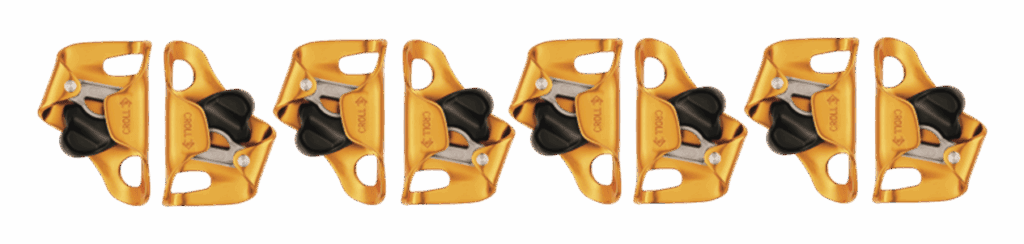
“Your Croll is on upside-down.”
“Oh, very funny.” I replied. She just looked at me.
I looked down. I looked again. I stared. My Croll ascender was on upside-down.
I was impressed by my own lapse, and quickly came up with a sequence of errors. In the past, I had always used an elastic loop around my shoulders to hold the Croll up. When the Croll was off, I always kept track of it by leaving the small carabiner and elastic loop attached to the top hole.
But I had recently started using a light webbing chest harness that held the Croll up better when I tethered a heavy pack below the seat maillon. It had not been connected to the Croll. In paying attention to the new harness and putting it on, I had then distractedly put the wrong end of the Croll through the seat maillon.
Due to the heat on the surface and in the cave, I was wearing a loose Supplex shirt that partly obscured the Croll area. I was thinking about photo gear and survey gear instead of my life support gear. I forgot my mental checklist.
I fixed the Croll, did a cross-check of Valerie’s rig, and we went caving, on the lookout for more errors.
The importance of remembering
Let’s assume that we had not done the gear check, and that I had missed the error again when I attached my rack carabiner to the maillon. What would have happened? Probably nothing at all. That’s the funny thing about safety. You can be unsafe in thinking and in action, and get away with it-until you don’t. But I probably would have reached the bottom of the cave, gotten ready to ascend, shaken my head, and fixed the problem.
But what if I had to switch over from rappel to ascend? This happens occasionally, even if you aren’t the first one down and find yourself at the knot in the end of the rope. You may find a tangle, or the rope running the wrong way around an obstacle, or a rebelay issue. You may miss a pendulum point, and have to ascend up a section of rope. Rockfall may even sever the rope below you. You may have to ascend quickly because someone becomes disabled on rope or off rope and needs help.
If a changeover is needed, an upside-down Croll would be a problem because the seat maillon cannot be opened in vertical flight, if you will. I always carry an ascender safety, thus giving me a spare. But it would still be awkward and slow compared to the streamlined Croll. And, generally, when a changeover is unexpected, something has gone wrong already. This raises stress and time pressure, which in turn increases the chances that a caver will make still more errors.
Like an aircraft starting to roll down the runway, vertical caving has crucial moments where things are either ready to go in advance or there will be great hazard or worse. Rack bars are of course a perfect example.
I have learned that five factors underlie a wide range of incidents and accidents everywhere people do complex operations from aircraft, to railways, to ships, to factories, to construction, to healthcare, to physical and computer security, to caving, and many more:
Haste. With all the work of hiking to the cave and getting project gear ready, there was less time to perform actions and I did them more hastily with less self-checking.
Change in routine. It was some new gear, a new cave, and a hard hike to the cave that I had not done before.
Distraction. Preparing to cave often includes some anticipation and adrenaline. These emotions ready us for survival. But they can distract us from small but important details. Then we have events arising from nature (think weather), the mind (stray thoughts or suddenly remembering something else), or other people (questions, requests) that draw our attention away at critical moments. We return to what we were doing… What was I doing? Oh right, I was just about to put on my Croll. But sometimes something is lost along the trail of thoughts.
Fatigue. A fatigued brain makes extra errors, and is less likely to catch these errors. For example, experiments have shown that getting 4-5 hours of sleep in 24 hours causes driving impairment comparable to the legal alcohol limit. Long cave trips always include fatigue. As fatigue increases, dialing back what we do (e.g., free climbs), and self-checks and cross checks with team members become more important.
Experience is great, until it isn’t. In many high risk endeavors, researchers have noticed a pattern. Very experienced people make very few errors. But when a very experienced person does make an error… it tends to be very bad, often fatal.
Excess confidence. Like very experienced pilots, very experienced cavers can begin to assume that their long record of safety ensures future safety. But as the hours and trips pile up, rare events occur. Like flying, caving is a one-strike game, not a three-strike game. Cross checks are a small investment that can pay off big even for the most experienced caver: “You never know what a second set of eyes might find.”
Thanks to Corey Hackley, John Lyles, Tommy Shifflett, Amy Skowronski, and Bill Storage for pre-flighting this article.
Additional information
“The accident risk associated with driving after having slept for only 4-5 hours is similar to the crash risk associated with driving with a breath alcohol content (BAC) of 0.08 (the legal limit in all U.S. states); which increases to BAC 0.12-0.15 after sleeping < 4 hours. (Czeisler, 2016; Compton, 2015; Bloomberg, 2005).” (US Army, 2020)
“Hill has experienced only one major accident in her climbing career. On May 9, 1989, she fell during a climb in Buoux, France; after forgetting to tie a safety rope, she fell 85 ft (25 m) into a tree, and was knocked unconscious, dislocated her left elbow and broke a bone in her foot.” https://en.wikipedia.org/wiki/Lynn_Hill#Notable_ascents
US Army. (2020). Comprehensive Fatigue Management: Maintaining Cognitive Dominance and the Tactical Advantage in Multi-Domain Operations. https://www.wrair.army.mil/sites/default/files/2020-05/Comprehensive_Fatigue_Mgmt_IP.pdf
First published in the NSS News, October 2022. This is V11 with banner update.
Please give us feedback, questions, and your experiences. What have you forgotten in caving? How do you reduce forgetting? Have cross-checks helped you? What are the pros and cons? Have you seen any specific problems? What are we missing about cross-checks? Write to John and Geary at [email protected] Anonymity is fine if you prefer.
Feedback from readers
“Buddy check is a standard with everyone I cave with.” – Tony Schmitt on FB, 4/18/25
https://www.facebook.com/groups/caversgroup/posts/10161163923923639
