
Safety & Techniques Committee (STC)
NSS Safety & Techniques: We discover and create information to make cavers safer, more effective, and more efficient.
Our Products
P3: Past, Present, Plan: Quick questions for good decisions in low airspace caving in the September 2025 NSS News.
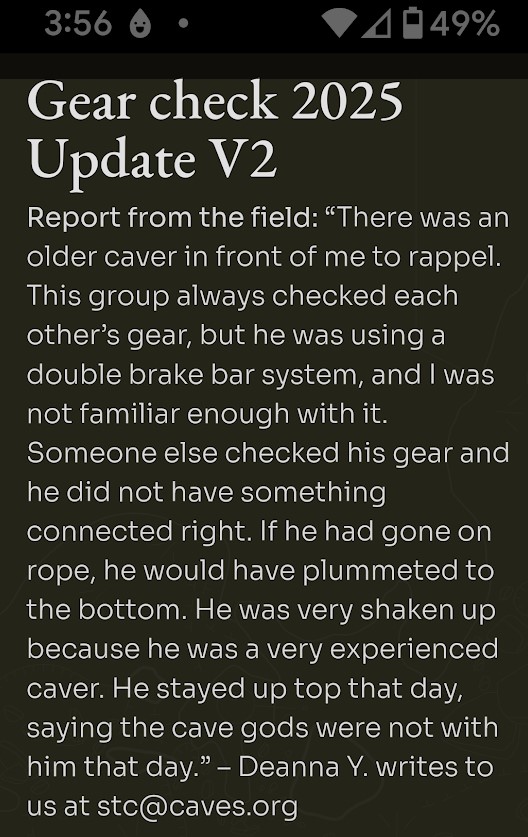
Gear Check article: Catching vertical errors before they catch us (Updated for 2025), with Audio Podcast for driving to the caves, commuting, exercising, etc.
NEW Field Notes #1: Favorite Hangers and Bolts 2026 by Max Elfelt
Prefer to read on your phone? Scan the QR code below with your phone camera or QR app, which will bring you back to this page. Click on the link above to browse with Chrome in Dark mode (iOS) or Dark theme (Android) or with Firefox iOS Night Mode or Android.
Android dark theme looks like this, which reduces eyestrain (at full size on your phone):
Goals (March 2025)
As guided by the NSS Board of Governors, the STC is currently focusing on six areas of work:
STC Vision (v7)
To cave safely, we balance technology, thinking, and skills in a system that adapts to the underground environment. STC investigates caving systems to understand system performance, including incidents and accidents (with ACA), opportunities for new technology and techniques, and training development (with VTC and NCRC). We analyze hard caving, our own and others, for observational data and insights. We conduct interviews and ask lots of questions. We tap into science and engineering theory ranging from karst flooding to the physics of ropes to the neuroscience of fatigue.
We study, model, and predict caving systems with graphics, animations, 3D models, and digital simulations. In the laboratory, we conduct experiments like destructive testing of hardware to validate theory, and then we create new experiments based on that updated theory. We make predictions and then we test those predictions, looking for the surprises that point towards new questions to be answered.
We produce articles and other media that are compelling, accurate, educational, story-based, and fun. We distill our research and testing down to crisp guidelines for cavers to use, with additional details and references a few clicks away for those who want to see the data and the underlying theory.
We step back from debates to show how a range of opinions develops naturally, and the pros, cons, and unknowns of different viewpoints. To increase quality and completeness, we work with multiple authors and multiple technical reviewers from a range of backgrounds and experience levels. To increase impact, learning, and recruitment, we release products across a range of media: magazines to video to webinars. To maintain trust, we issue corrections and updates as we learn. We track progress and discover new needs in the community with continuous feedback from our users.
Ambitious? Yes. But small teams and crowdsourcing are powerful. Be an innovator with us, see below.
Future work
Be an innovator with the STC team! (v2)
We’re looking for a small team of cavers with energy, skills, and ideas in the following areas:
International partners to help us learn about related work going on around the caving world and identify opportunities for collaboration. As just one example, there has been extensive work in Europe on concrete screws for caving.
Research curator. There is a large hidden literature on safety and techniques, including past work by the STC. We want to build a comprehensive library and database of this material, to include conversational AI and data mining interfaces. Eventually, this could link to initiatives like the ACA database and possibly UK and European projects.
Illustrator and Animator. Create powerful new graphics and animations.
Media producer. We are keeping things simple to start, but we will need assistance with web design, podcasts, webinars, and video. (And many thanks to the excellent technical reviewers and editors who are helping currently.)
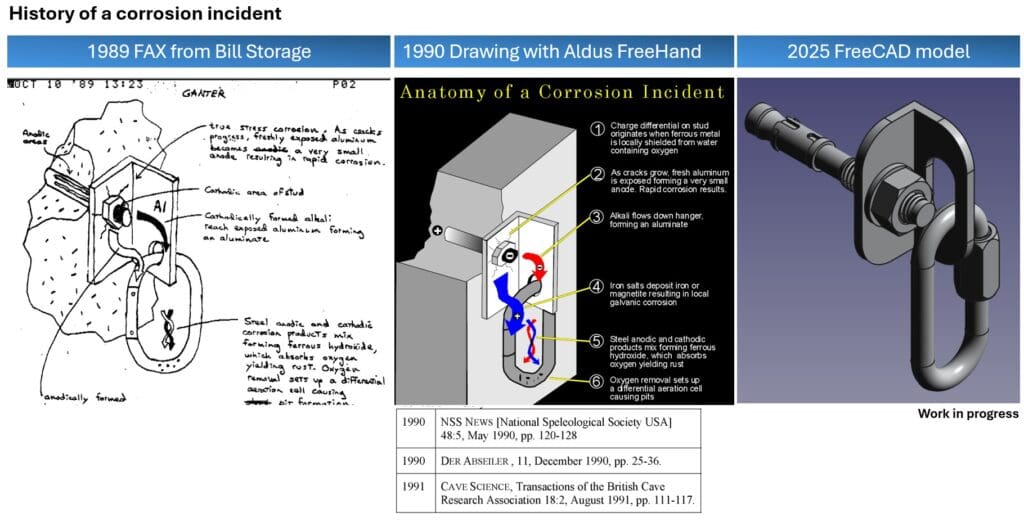
3D modeler. Build up a library of FreeCad models of caving hardware, which will be released as open source at an appropriate time
Mechanical modeler. Work with the 3D models to perform static and dynamic analyses, such as finite element modeling to show stress and strain patterns
How else could you help? We want to hear your ideas.
Interested but not sure you have the skills yet? We may be able to hook you up with another caver to learn. Visualize yourself teaming in Twitch to create an illustration.
The reward? Satisfaction in helping the community to cave safer and better. Seeing your name in print. And you can put this volunteer work on your resume or vita. You will also get some cool bling.
Interested? Know somebody else who might be interested? Reach out to John and Geary with a single email to [email protected]
About the STC
The NSS Safety & Techniques Committee (STC) has been a part of the NSS for many years. The restart began on 3/24/25 with the appointment of John Ganter and Geary Schindel as co-chairs.
John Ganter NSS 22870LF has published on systems engineering, accident analysis, and the physics of ropes and anchors. He is founder of the NSS Survey and Cartography Section. John’s goal is applying human performance science and engineering to caving safety and techniques.
Geary Schindel NSS 15827LF is a professional geologist and has written on vertical and caving safety. He is past president and AVP of the NSS and a board member of the new Vertical Training Commission (VTC).
Reach John and Geary with a single email to [email protected]. We will ask permission to use anything you share, and anonymity is fine if you prefer.
22 March 2026 · v23
