
P3: Past, Present, Plan: Quick questions for good decisions in low airspace caving
*NEW* Audio Podcast, listen while driving to the caves, commuting, exercising, etc.
John Ganter, Bill Storage, Keely Owens, Ben Miller, Adia Sovie, Ryan Boyce, and Geary Schindel
3/22/26 V37, featured in the September 2025 NSS News
A project of the NSS Safety & Techniques Committee (STC) caves.org/stc
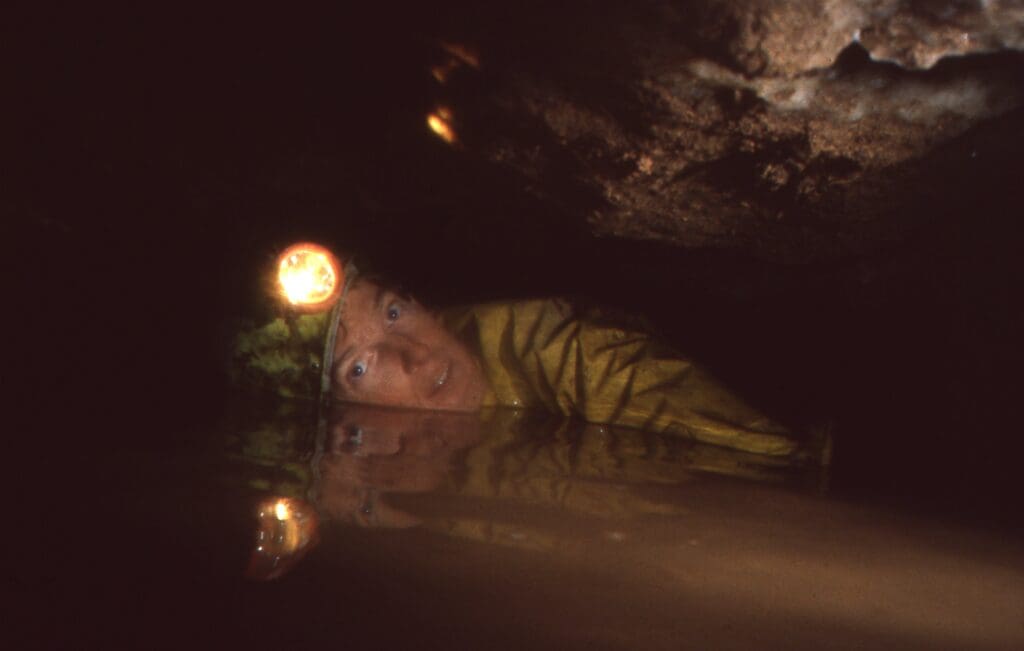
A promising lead ends in a partially flooded passage with just a few inches of airspace—but blowing wind beckons. Your mind races with the possibility of a borehole just on the other side, juxtaposed with scenes of hypothermia, flood waters, and getting stranded—or worse. How do you make sound decisions when encountering these daunting obstacles and exciting opportunities? This team of writers developed diagnostic questions for cavers, which we call P3: Past, Present, Plan.
Past: What do you know about the history of the cave and its flood potential?
Present: What are the current weather conditions and state of your team?
Plan: What options do you have to explore the feature and do you have the team and equipment resources to push hard but safely?
Arriving at a low airspace (a near-sump—commonly called a sump) always provides a thrill of anticipation. Maybe it’s a new discovery or, even if you’ve been through the feature many times, there may be exciting changes in water level, sediment arrangements, your own mental and physical readiness levels, and other surprises.
The “phase transition” from dryish to truly wet caving can be routine, but it can also be the beginning of an aquatic slippery slope of sorts that leads toward, well, doom. As one example, in many karst areas we are throwing dice with thunderstorms sitting on the other side of the betting table. But, even without flood events, lots can go wrong amid all the splashing and fun.
The phase transition is a great time to pause before getting really wet, do some thinking, do some talking, and figure out a plan of cautious advance and retreat. Herein we reflect on decades of experiences and recent diabolical low airspaces to come up with a quick decision aid called P3: Past, Present, and Plan.
Picture a timeline centered on you, the caver, right then and there, staring at the dark water, and some of the crucial questions that should run through your mind and the conversation that should ensue. In this article we’re addressing a range of cavers and caving, so the questions are both specific and general. Adapt as needed to your circumstances. There is also a [longer list of questions]; check these out and submit more. Be sure to check the hazardous air and contaminated water questions which are beyond the scope of this short article. Stay tuned for the next article which will review the state of the art in low airspace techniques and equipment.
P1: Past: History, events, and experiences
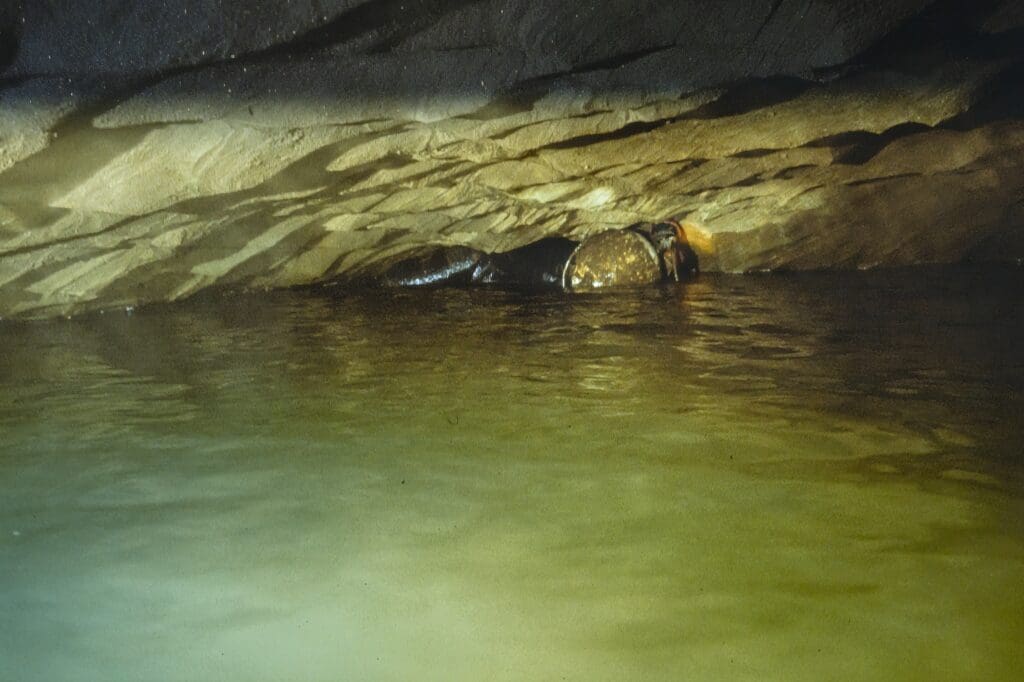
Before going underground: What is the history of flooding in this cave or area? What is the size of the drainage basin? What are past trends from the US Drought Monitor, present situation from the U.S.G.S Water Dashboard, and today’s weather forecast with special attention to the probability of storms later in the day? (links are in the online version, including a study of weather forecast accuracy). Is this area subject to highly localized storms, is there snow on the ground, is the soil saturated or dry, is vegetation active or dormant, does water enter or exit the cave? With these background questions, the team assembles information about their trip and gets a sense of what has happened and could happen while they are underground.
Now staring at a specific challenge, the team begins to diagnose the novelty of their situation and gauge whether they have enough information to make a decision. Is this feature a brand-new discovery? Is it something that has appeared since the last trip? Has anybody ever been through it? Who could we talk to about this and similar features? Are there trip reports or other documentation? Have accidents occurred here?
Next, the team can make observations and gather evidence to suggest more general conclusions (inferences) about the sump. Where has the sump water come from? Is it drip water or from flood events or is it an active stream? Is there evidence of recent flooding like sediment rearrangement or surface debris? Can we figure out what changed and/or did not change? For example, is this section wet when we expected it to be drier? Did it not dry out as expected (e.g., routine periodic flooding) or did it unexpectedly get wetter?
P2: Present situation and our team status
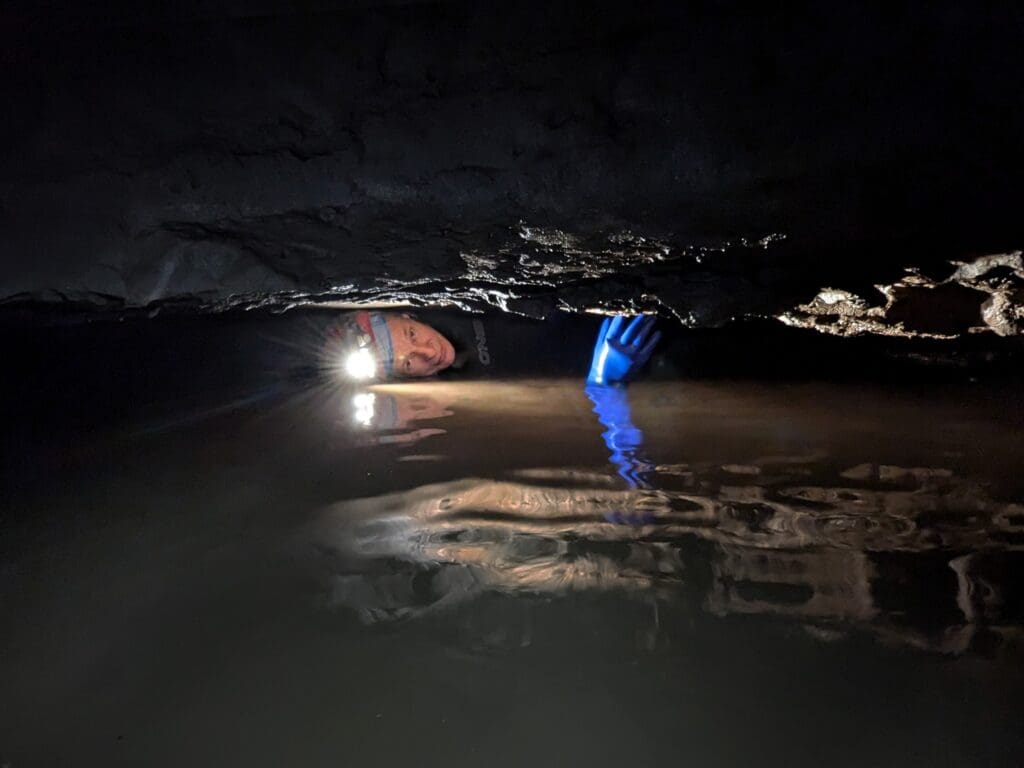
Now the team shifts its gaze and thinking from the cave challenge to themselves as a social unit considering that challenge with certain resources. First, human resources. What is the condition of our team, particularly its coldest and least experienced member? Was immersion part of the plan or is it a surprise? Are we wet and/or cold already? What is the water temperature? What is our experience in low airspace, attire and equipment, cold sensitivity, fatigue and hypothermia levels, preparedness for more cold,and overall health and readiness status of each person?
Next, the material resources. What kind of equipment do we have? This can range from wetsuits to dive lamps to a guideline and much more. But also, much less. Have we got what we need to do the caving safely and effectively?
And some crucial questions: do we need to modify our trip plan and/or quickly generate a new plan for coordinated action? Is the excitement of discovery affecting our ability to honestly assess our situation and team status? Are we being impulsive? Can we reduce at least some of the risks that result from our actions?
P3: Plan of action
The team has framed the cave situation and its own capability to do something about the opportunity. Now, they step back again to ask, what are our goals, limitations, and options?
What are the reasons for doing this right now? What are the reasons to come back later?
Should the team split up? One option is a fast reconnaissance by one caver, who is experienced, equipped, and motivated. This recon can provide vital information to make decisions, while most of the team stays drier and in readiness. On the other hand, having two experienced people in long low airspace can help greatly with navigation (the light behind and in front can act as beacons) and reduce optical illusions inherent in a single light, even when held at arm’s length. There are pros and cons to discuss.
And we must not forget the time element. What is the window of opportunity? Is this historically low water in drought conditions or can we come back any time we please?
What is the window of risk? What is the weather forecast and is there diurnal (24 hour cycle) risk like afternoon and evening thunderstorms? What are the consequences of flooding: being trapped for a day, or for an indeterminate period, or certain death because the passages beyond fill completely?
Is there any way to know what is going on in the surface world we left behind? What signals from the surface are we monitoring? Typically, these are changes in airflow, water flow, and water level.
The diagnostic questions above are distilled from many low airspace dramas and escapades we have experienced. One experience illustrates P3 through a story of the decisions that an exploration team needed to make.
An example of P3 applied to a past exploration trip
Bill and John had done an aid climb in West Virginia. At the top, walking passage disappeared into blackness. Meanwhile, in Tennessee, Marion O. Smith sensed a disturbance in the speleo force that signaled cave booty. For the first survey trip into the new discovery, Marion climbed into his truck and drove 300 miles up to the northlands.
The survey team explored for several hours before encountering an obstacle: a low, flooded crawlway without much airspace. It looked grim but the airflow was strong
P1: The Past. What do we know about the past history of this feature? We are in virgin passage, but we still have local context and precedent to think about and discuss. The passage is heading out into a large blank area on the existing map, terra incognita: “Here be Dragons”. We have already speculated that this new find could be a fossil route to another parallel drainage basin, so this lead is worth effort and investment. We are hunkering in an ancient fossil passage now 30 feet above the active cave stream. Flood risk appears low, based on current theory (the why) and current evidence (the what). The water may be from a storm event and gradually drain and/or evaporate. And in this cave system, we know that comparable features are often navigable and rise again into more pleasant passage. But the air could also be coming out of impossibly low passage (can’t crawl further) or no airspace (can’t breathe any more) or a pile of breakdown (can’t fit any more).
P2: The Present. What is our situation, right here and now? The team is experienced, damp, cold, slightly fatigued, stoic. Is this the only option to move forward? Yes, we have been thorough. Anything else is a dig, and this is the only source of airflow. This next section is the only viable way onward and obviously requires full immersion at least for some distance. We are all wearing thick fleece, oversuits, and balaclavas, and are not keen to get completely wet and then survey onward soaked. We can come back. But on the other hand, what if we come back with wetsuits and this feature ends quickly?
P3: The Plan. What is our plan for this low airspace? We agree that one person should probe ahead, see if it’s possible to get through, and reconnoiter for no more than a few minutes out of earshot. If the caver is gone for more than a few minutes, we will sail to the rescue. But who? Marion is wearing a thin wetsuit top under his oversuit. The helmets of the team slowly turn toward the dark lord. A nomination of honor. Marion declares the discussion adjourned with “The Horruh!” —and launches.
Splashing, grunting, and grumping fade into the distance. We wait patiently, silent, listening for signals from the space probe.
After a few minutes, a faint sound portends the return of the indomitable caveman. Splashing and grunting move steadily closer. But no grumping? Marion surges ashore like a landing craft, draining water.
“So, what is it like, Marion?”
“The h o r r o r,” Marion explains patiently. With this formality out of the way, Marion calmly reports that the feature is not bad at all: mostly smooth sliding on mud, only an ear dip at worst, and then it rises into walking passage which he had checked for a hundred feet or so. It continues out of sight. Big. Marion is perfectly expressionless as he reports this information.
An excellent recon. We now have information about passage character and the gear needed to plan the next trip. Marion is now very cold, so he takes the lead up the rope drops and is sitting contentedly on his tailgate when the rest of us emerge. He pushed, he found. The story of his life.
Let’s consider an alternative scenario. Suppose the air draft had been flowing out of impossibly low passage and/or low airspace. Once again, only one chilled caver makes this determination, instead of the whole team. In that case we would have retreated, drawn the map, and shifted efforts elsewhere in the system but periodically rechecked the lead to see if changes in surface runoff or shifting airflow had lowered the water level by evaporation. The recon could have provided information on gear to bring, such as digging tools for sediment or boulders.
We just demonstrated P3 in-cave, retrospectively, on one of the many trips that inspired it. But obviously P3 can be used pre-trip and post-trip. As the trip just completed becomes the past, the team reflects and discusses in the present, and a plan is built for the next trip. What did we learn? What do we think? What is next?
Summary of P3
P3: Past? Present? Plan? What has come before, what is our situation and posture now, what are our options for actions? Diagnostic questions to use on your next cave trip. Think broad, think narrow, use your words, talk it through, act and adapt.
The online version with more diagnostic questions and additional photos and map examples is at caves.org/stc. Listen to the podcast version here also. Submit feedback and additional diagnostic questions to [email protected].
We thank the technical reviewers for their many suggestions: Jennifer Arbeiter, Hunter Campbell, Jennifer Dougherty, Yvonne Droms, Dave Hughes, John Lyles, Laurie MacDougall, Mark Minton, Bill Steele, and Tim White. The opinions expressed are those of the authors.
Please submit questions, comments, suggestions, and corrections to [email protected]
4/2/25 V30 submission to NSS News (2200 words)
4/17/25 V31 corrected links
8/16/25 V33 Posted online: https://caves.org/p3-past-present-plan-quick-questions-for-good-decisions-in-low-airspace-caving/
8/24/25 Posted on Cavers of Facebook https://www.facebook.com/groups/caversgroup/posts/10161706712618639/
