


Event Overview
The National Cave Rescue Commission (NCRC) Southeastern Region will hold two four-day Small Party Assisted Rescue (SPAR) seminars March 7 – 10 and March 12 – 15, 2026 at the Little River Property (former site of the TAG Fall Cave-In) in Menlo, Georgia. Class size will be limited to 12-16 students (depending on instructor availability).
To make the course registration process more equitable and accessible, we are conducting a pre-registration process. Students may enter the pre-registration lottery for either or both courses, but will only be registered for one course. The pre-registration window is open from Noon Eastern on December 19, 2025 through 11:59 pm Eastern on December 28, 2025. After the pre-registration window has closed, if more people have pre-registered for a course than there are places available, we will select registrants for open slots by random drawing. If selected, you will automatically be charged for the course; be sure to read the cancellation policy (below) before pre-registering.
Cost, which includes on-site camping, showers, and some meals (see below), is $340 for current NSS members; $390 for non-NSS members. Non-NSS members may pre-register at the NSS member rate by first joining or renewing NSS membership (note: you may actually save money if you do this, especially if you are under 26!).
-
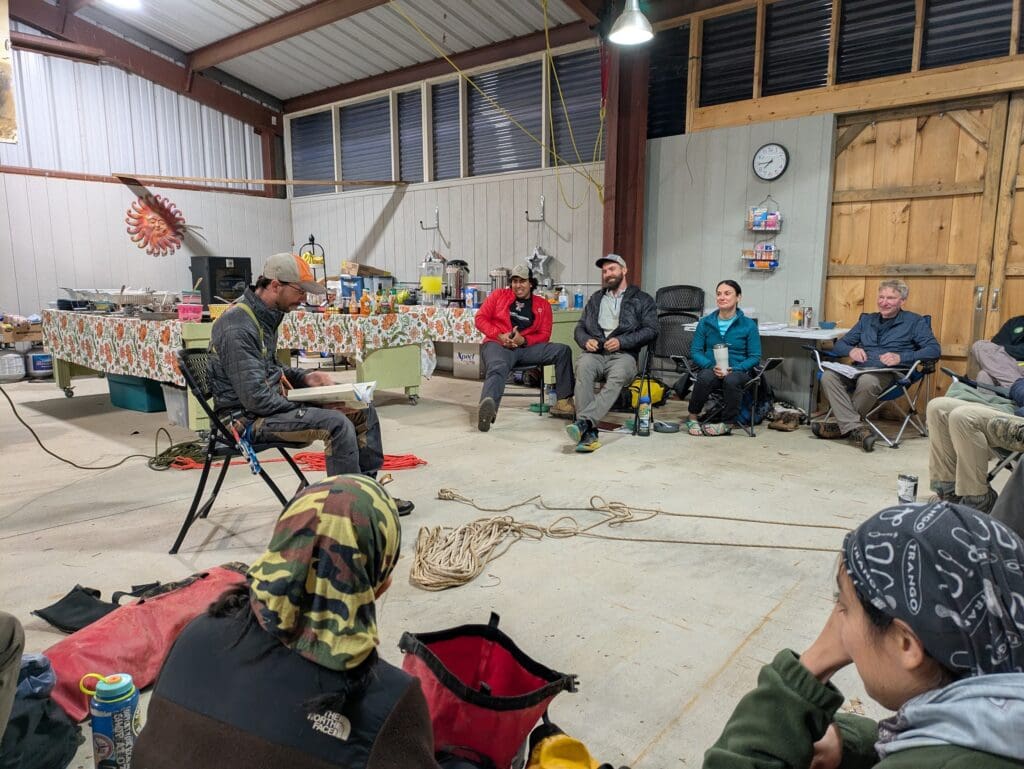
- Knotcraft session – a reading from the “Book of Ashley” (photo credit: Bri Bennett)

-
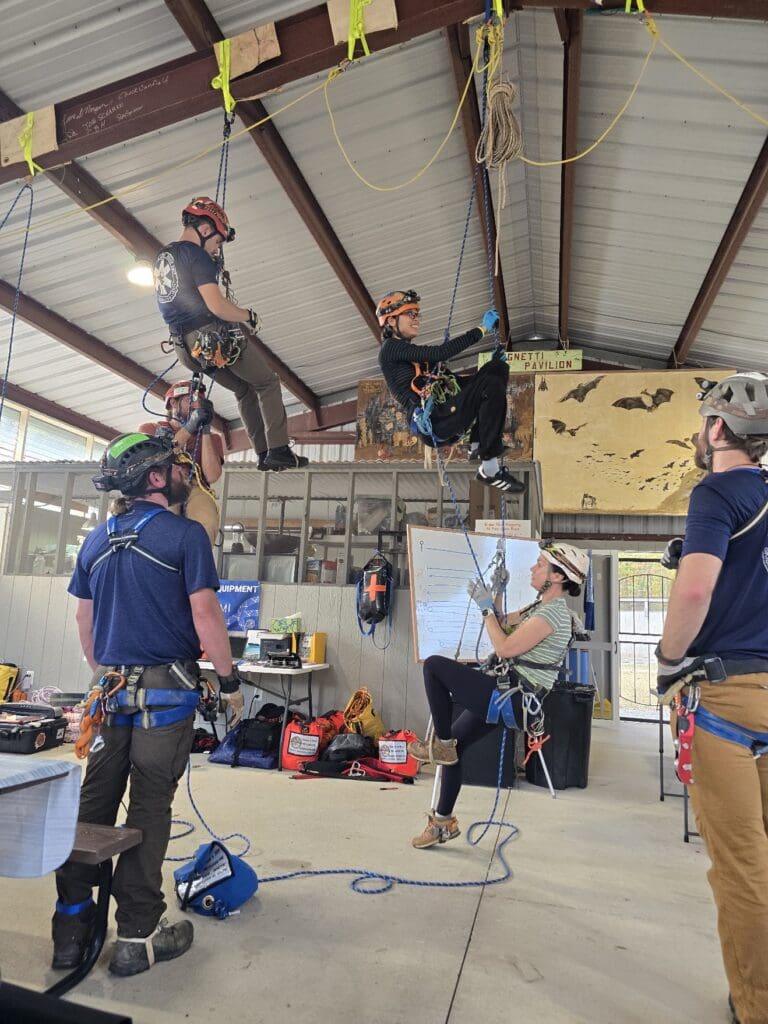
- Diminishing loop counterweight haul – one of the fundamental SPAR skills (photo credit – Ron Miller)

-
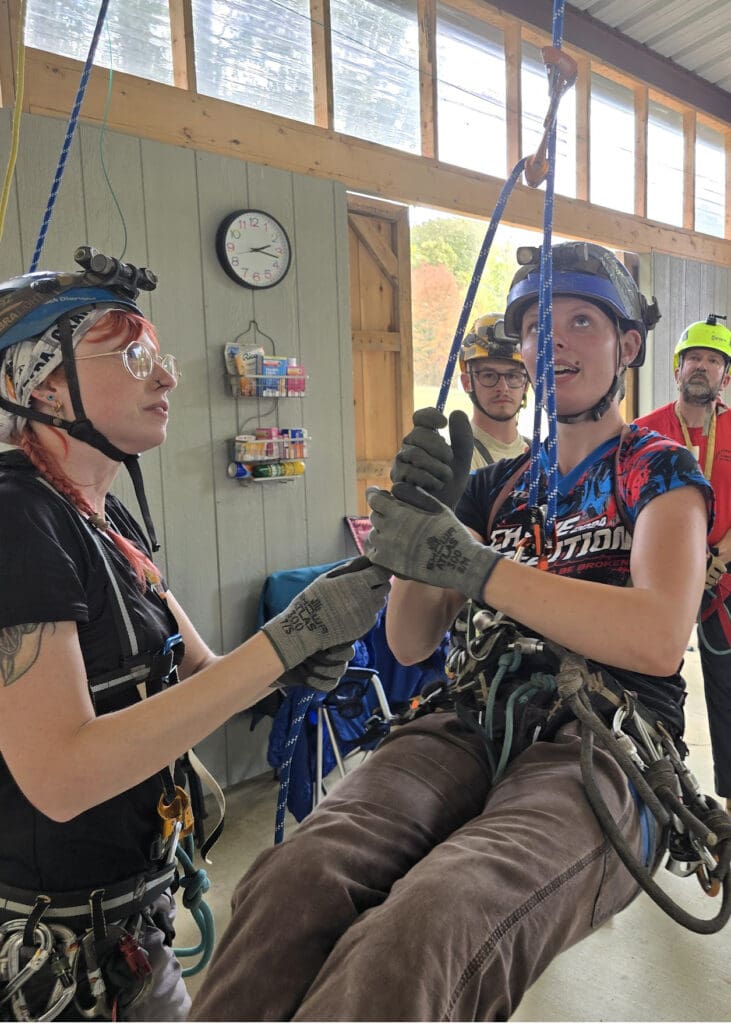
- Traveling haul – one of the fundamental SPAR skills (photo credit: Rachel Saker)

-

- Rappelling counterweight haul practice in a cave (photo credit: Ron Miller)

-
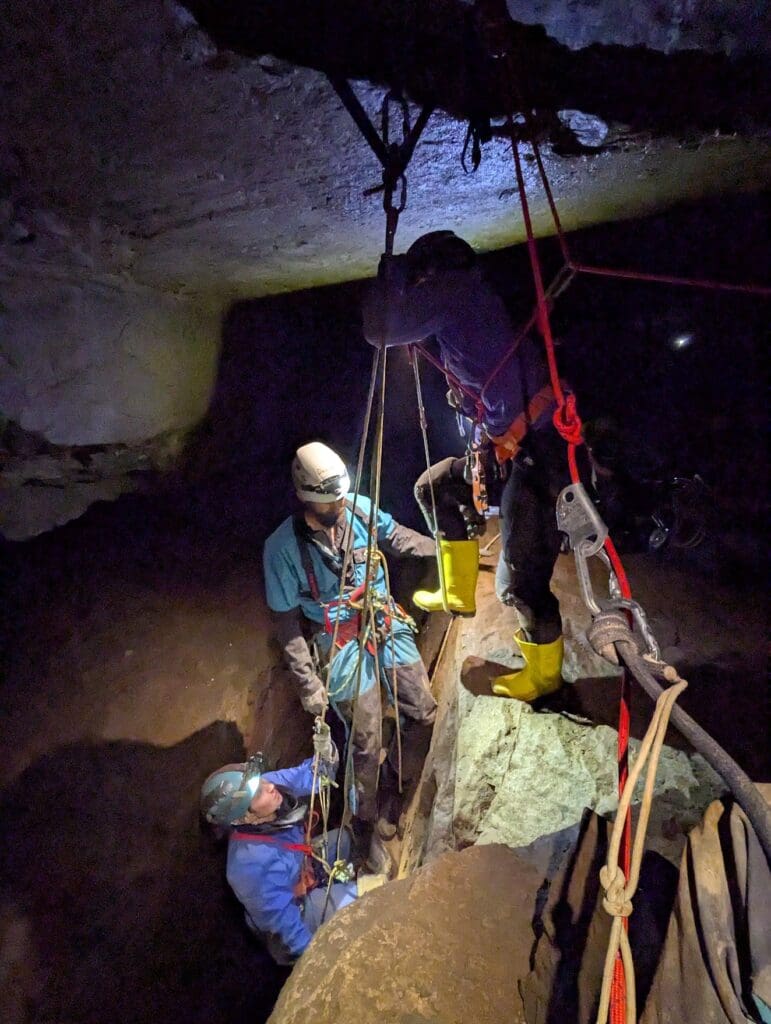
- Climbing counterweight haul practice in a cave (photo credit: Reilly Blackwell)

-
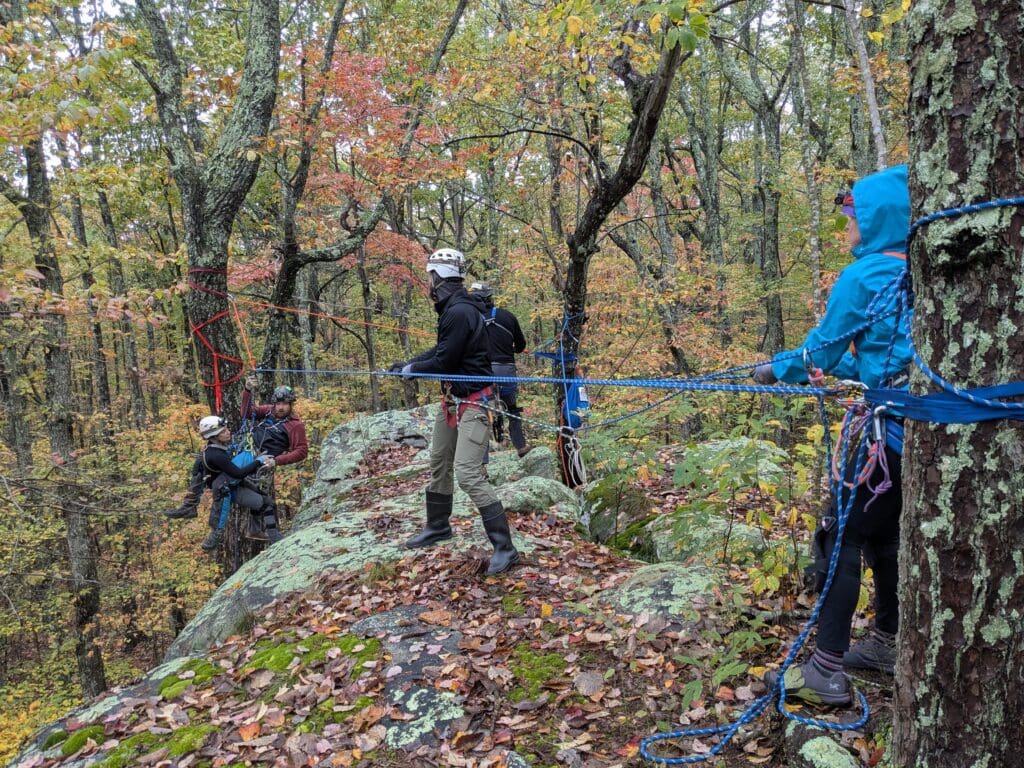
- “Spider Rig” – a diminishing-loop counterweight haul, paired with a cross haul to negotiate the edge at the top (photo credit: Ron Miller)

-
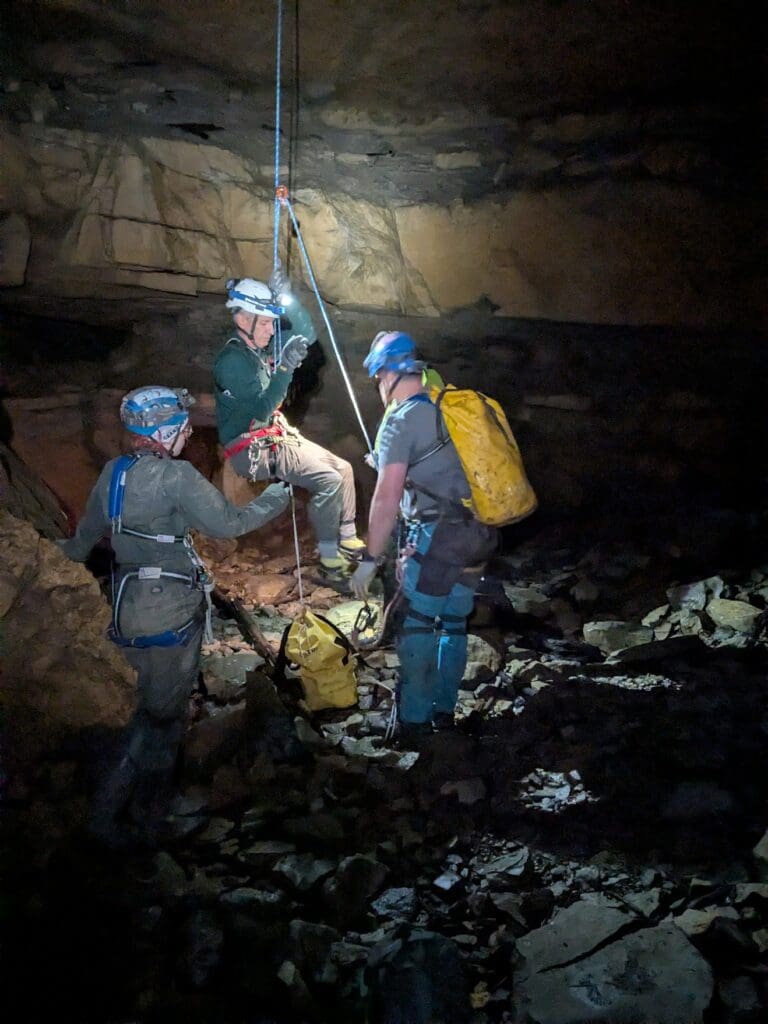
- Mini-mock scenario – students used a traveling haul to rescue an “ill” instructor (photo credit: Ron Miller)

-
National Cave Rescue Commission (NCRC)
-
March 7 - March 15
Event Details
This NCRC Small Party Assisted Rescue (SPAR) seminar is an intensive four-day introduction to cave rescue techniques that a party of six or fewer people can perform, using minimal gear that can be carried on caving trips. Topics covered in the class include preventing and preparing for common caving-related problems, basic medical skills, moving patients through obstacles, helping people who are stuck on rope, and building and operating haul and lower systems.
The seminar provides approximately 40 hours of instruction over four days. The classes are physically strenuous and participants must be in good health. Students should be prepared to work in difficult situations, both above and below ground.
Students will need to study some material in advance so that the sessions reinforce and build on on existing information. Students will practice skills in a rope gym setting, and then will build on those skills at cliff and cave sites. The course will be demanding, with long days and evenings, but will provide participants with valuable skills that they can use to help themselves and others when they are needed most.
For safety and class efficiency, students should already be competent and comfortable with knot-tying and vertical-caving skills. Before taking the course, all students must successfully demonstrate the knot-tying and single-rope-technique (SRT) skills described in the SPAR student preparation guide.
We encourage students to contact an NCRC instructor to complete their skills demonstration prior to the class. For any students who are unable to complete this in advance, we will hold a skills demonstration session at the course site on Friday evening, March 6th for the first course, and on Wednesday evening, March 11 for the second course.
For the first course, students should plan to arrive and check in Friday evening, March 6 (Day 0), from 5 – 9 p.m.
For the second course, students should plan to arrive and check in Wednesday evening, March 11 (Day 0), from 5 – 9 p.m.
For both courses, course sessions on Days 1 through 4 will start promptly at 8:00 a.m. We will continue after dinner until about 9:30 p.m on Days 1 through 3 and will conclude around 6:00 p.m on Day 4. The schedule is subject to change at the discretion of the instructors.
Students should come prepared each day with food, water, and appropriate gear and clothing for classroom, rope gym, and cliff or cave activities.
The 160-acre Little River property, located at 2477 Old State Rd in Menlo, GA and the former site of the TAG Fall Cave-In, will be our base camp. This will be our location for camping with showers, group meals, and classroom and rope-gym sessions.
The course fee covers meals from dinner the first evening (Day 0) through lunch on Day 4. We will do our best to accommodate dietary preferences and restrictions shared at pre-registration, but please remember you are ultimately responsible for your own health.
This course will include field exercises at cliffs and caves in northwest Georgia and southeastern Tennessee. Daytime highs in March are likely to be in the 50s to 60s, with nighttime lows typically near or below freezing. Cave temperatures are likely to be about 54 °F.
Student initiated cancellations will incur the following fees:
Before Jan 16 - $25.00.
Jan 16 - Feb 15 - 25% of course fee.
After Feb 15 - no refund.
All gear must be clean and in good condition. Synthetic-based life-safety gear (e.g., helmets, harnesses, cordage, etc.) must be less than 10 years from date of manufacture.
1. HELMET. Caving or climbing helmet, UIAA or CE approved, with a 3 or 4-point non-elastic chinstrap.
2. HEADLAMPS. Three, must be electric.
3. SEAT HARNESS. Commercially sewn.
4. ASCENDING SYSTEM.
- Two mechanical ascenders, connected to the seat harness either directly or with a cowstail (also called a tether or lanyard);
- A second cowstail connected to the seat harness, with a locking carabiner on the free end;
- Cowstails may be a commercial product designed for this use, or tied with dynamic rope of at least 9mm diameter.
- Locking carabiners are required on all cowstails that may be used to make a life-safety connection.
5. DESCENDER. Rack (standard, micro-rack w/ hyperbar, or Scarab), bobbin with friction device, or static-cam device (e.g. Petzl I’D or Rig, Skylotec Sirius or Spark).
6. RUGGED CLOTHING. Synthetic, wicking, and insulating.
7. GLOVES. Leather or sturdy synthetic gloves.
8. BOOTS. Sturdy, lug-soled boots with good support.
9. FOOD. Quick energy, ready to eat snacks.
10. WATER. 2 liters capacity recommended (enough to stay hydrated for a full day of field work).
11. SMALL PACK. Rugged enough for the cave environment.
12. TWO CARABINERS. Two extra locking carabiners that are not part of your SRT gear.
13. WEBBING (1”) or ACCESSORY CORD (7+ mm). 15+ feet long, at least 10 kN minimum breaking strength (MBS).
14. RESCUE GEAR (optional). Any pulleys, Prusiks, or small rescue gear (e.g. Petzl Micro Traxion, Tibloc, Rollclip) that you normally carry in your cave pack.
15. CAMP CHAIR (optional, but recommended for classroom and rope-gym sessions).
We will be following local and state recommendations. At this time, masks are optional, and we fully support anyone who chooses to wear one.
If you suspect you may have Covid and/or show Covid-like symptoms, or if you have a communicable disease such as flu or RSV and may be contagious, please be respectful of your fellow course participants and do not attend the course (we will waive any cancellation fee).
The fungus responsible for causing WNS in bats has been detected for several years in caves in the counties in which the seminar will be held, so all caves visited during the seminar should be considered WNS-contaminated. Decontamination is not required before or during the seminar, but we recommend that attendees clean and disinfect their gear after the seminar, according to the latest protocols: https://www.whitenosesyndrome.org/topics/decontamination.
The National Cave Rescue Commission is a commission of the National Speleological Society (NSS). It serves as NSS’s representative on issues of cave rescue training and operations. By design, NCRC is not an operating cave rescue team. Rather, its mission is to provide training and development opportunities for persons and organizations engaged in cave rescue activities.
For questions regarding gear, prerequisites, or seminar material, contact Cathy Borer.
For questions regarding registration or course logistics, contact Ron Miller.
