
The Cave Art of Tom Culverwell
The Cave Art of Tom Culverwell
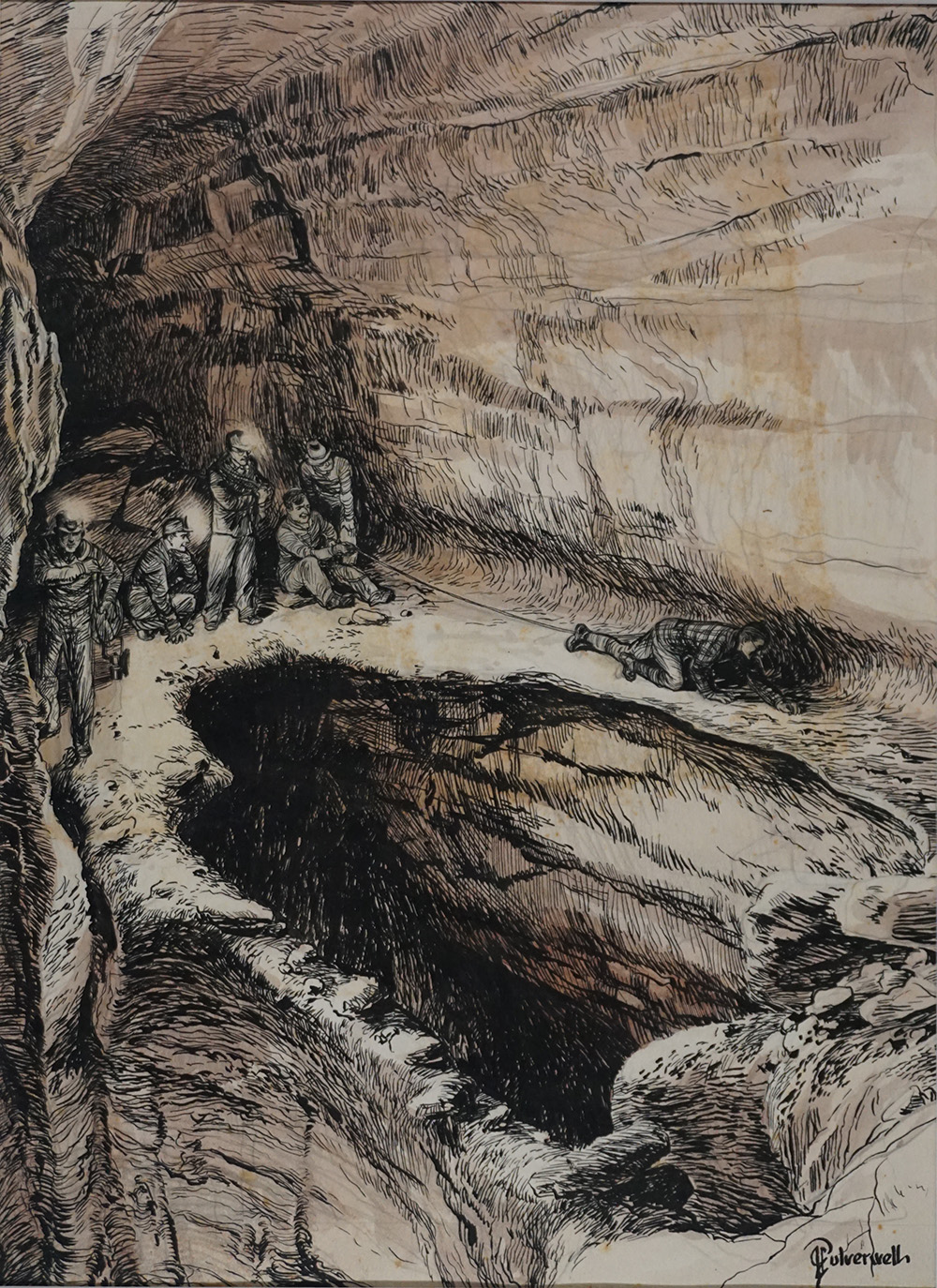
The Great Gallery
People have been exploring caves ever since there were people on Earth. In most of that time the interest in caves was mostly utilitarian. Caves were used for shelter, storage of food, religious purposes and mined for minerals. In the early 1900’s people in America began to develop an interest in the outdoors for recreation including hiking. Some groups that were formed to promote hiking would also explore caves that they found during hiking trips. During the 1930’s several groups were formed for the purpose of finding and exploring caves.
In 1939, intrepid members of the fledgling Speleological Society of the District of Columbia took a stab at penetrating the unknown portions of Schoolhouse Cave. Dangling on a crude ladder below the Jumping-Off Place gave explorer Don Bloch a quick look-see at what lay beyond. Although getting that far was a major achievement in its own right, the perilous descent also convinced Don that penetrating much further into Schoolhouse Cave would require skills far beyond anything that the nascent group currently possessed.
This initial probe was written up in the local newspaper–a daily which enjoyed wide circulation in the Washington, D.C., area. The readership included members of the Potomac Appalachian Trail Club–a group of hikers, climbers, and outdoors enthusiasts always on the lookout for a new adventure.
In February of the calendar year after Bloch’s initial reconnaissance, a handful of elite mountaineers from the Potomac Appalachian Trail Club entered Schoolhouse Cave. Initially, they were simply looking for an outdoor gymnasium in which to further hone their rock climbing skills. Preferably, such a practice place would afford some shelter from the outside weather. But, fascinated by what they saw at Schoolhouse, these pioneering explorers immediately recognized the adventure of exploring the cave for its own sake. They returned again and again. For them, Schoolhouse Cave provided all of the excitement of “underground mountaineering.” It was difficult, dangerous, and then some.
Before they were through, a member of the Potomac Appalachian Trail Club named Tom Speiden Culverwell made a number of detailed sketches illustrating these early explorations. Culverwell’s beautiful drawings excite and inspire Schoolhouse Cave aficionados even to this day. In fact, Tom’s sketches are so historic and so captivating that some now grace the headquarters of the National Speleological Society.
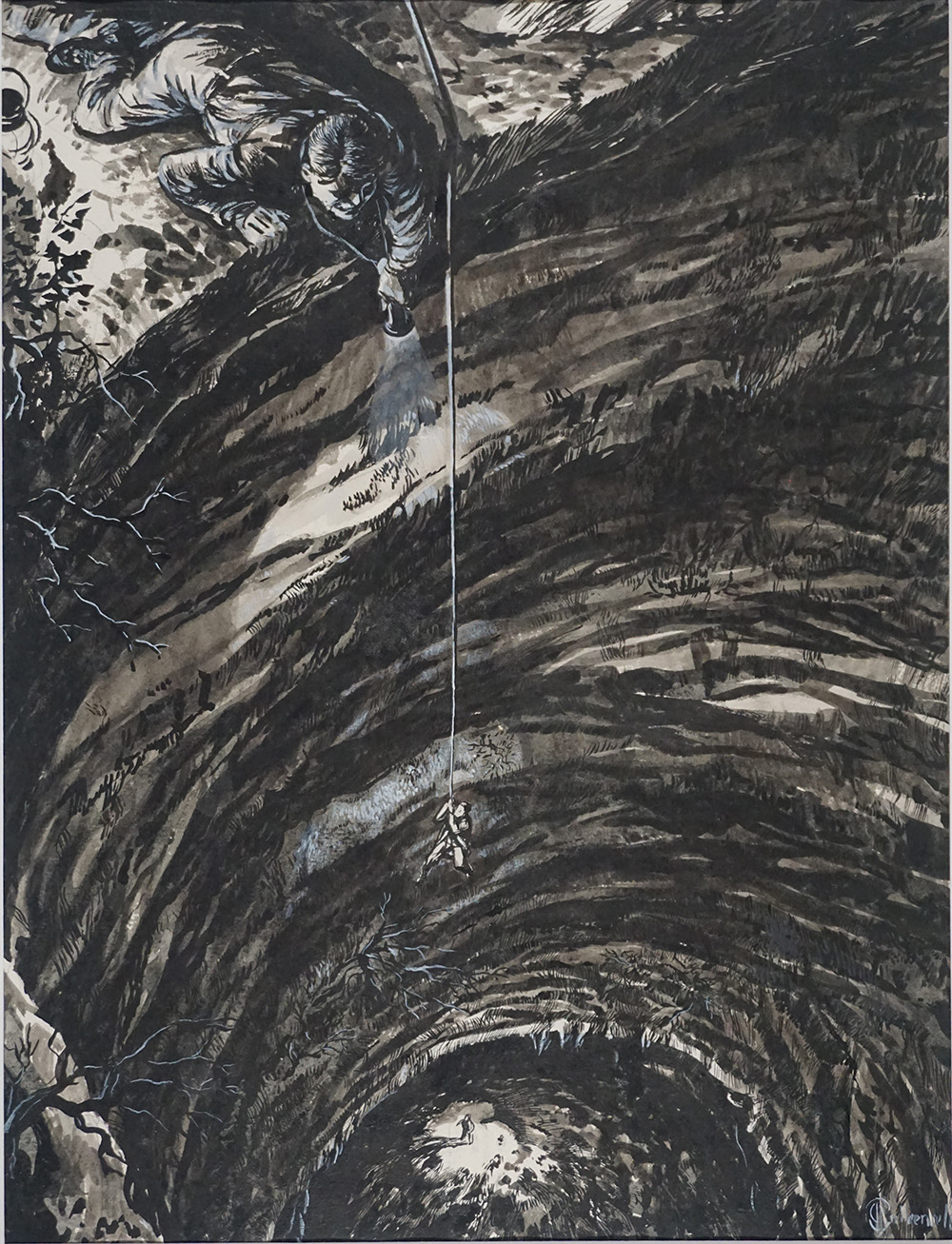
Descent into Devil’s Sinkhole
This drawing was inspired by certain aspects of the first exploration conducted by members of the National Speleological Society to the Devil’s Sinkhole in Texas during the winter of 1947.
In this depiction, the first man down, Floyd Potter, is seen standing at the top of a huge mountain of rock and travertine. It is well after dark as Ralph Velasco is being lowered down to join Floyd. The crude descents are accomplished by utilizing a 3/8-inch cable tied off to the bumper of a two-door Plymouth sedan. By driving the automobile back and forth along the surface, the attached cable is raised and lowered.
Eddie Raney is shown perched on the very brink of the shaft, peering below with the assistance of his flashlight. From this spectacular position, Ed is able to shout progress reports and driving instructions over to Pat White, who is maneuvering the car outside the field of view of this image.
This drawing was used as the lead graphic in a feature article prepared by Patrick J. White for the National Speleological Society’s Bulletin Ten–The Caves of Texas. In appreciation for Tom Culverwell’s fine illustration, Pat White wrote:
Please tell Tom Culverwell that we who participated in the Sinkhole Soiree think he did a terrific job on the frontispiece and can’t figure out how on earth he was able to so accurately portray a hole which (presumably) he has never seen. Actually, the picture looks as though Culverwell has set up his easel at the hole and painted from “life.”
This is the only cave-related drawing by Tom Culverwell that does not depict a situation in a Pendleton County, West Virginia, cave.
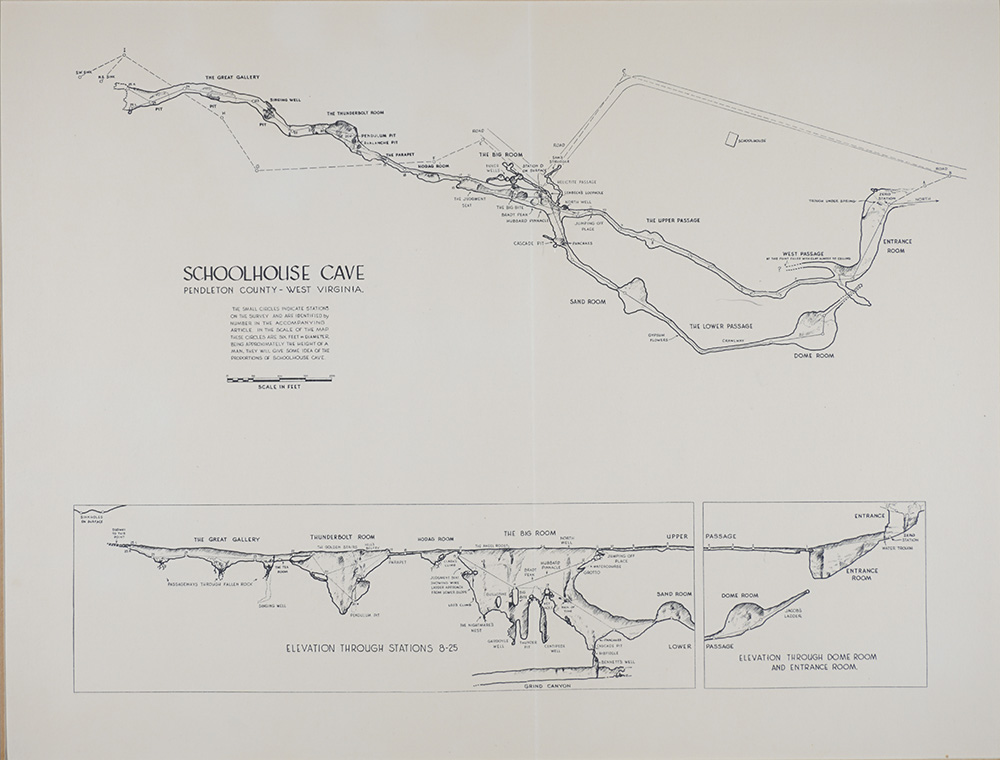
Schoolhouse Cave
After learning of Schoolhouse Cave from a November 1939 article appearing in the Washington Star, the Potomac Appalachian Trail Club began their own explorations of the cavern in February of 1940.
As their exploratory work progressed in Schoolhouse Cave, the climbers deemed it helpful to document what they saw. Tom Culverwell, a professional illustrator, took it upon himself to prepare some preliminary sketches. To calibrate the sketches, Culverwell employed a compass and string.
When the climbers from the Potomac Appalachian Trail Club had finished their exploration of the challenging cavern, it was widely acknowledged that a trip to the back of Schoolhouse Cave was a lengthy and serious undertaking. Some searching on the surface near the presumed location of the cave’s terminus turned up several intriguing sinkholes. Could one or more of these surface features eventually provide a “shortcut” to the furthest recesses of Schoolhouse? To find out for sure, a detailed survey was required.
So, on Memorial Day of 1941, an engineering transit and steel tape survey was begun under the direction of Dr. Harold F. (“Stimmie”) Stimson. The group surveyed overland from the sinkholes on the surface to a datum established at the mouth of Schoolhouse Cave. Then, placing the 65-year-old engineering transit into an Adirondack pack basket, Stimmie’s team headed underground.
The location of each survey station was selected to provide an ideal line-of-sight for the transit. A few such stations were, of necessity, in precarious and difficult surroundings. On one occasion, even after repeated efforts at peering through the instrument, Dr. Stimson still could not see the light marking station number 17. Amused, Fitzhugh Clark suggested that things might work better if Stimmie were to go ahead and take the opaque dust cap off of the transit telescope!
Finally, mathematical analysis using tables of trigonometric functions permitted the coordinates of each survey station to be determined with respect to the datum. The result was a line plot of the traverse path.
This calibrated line plot was provided to Tom Culverwell where it served as the “skeleton” for the detailed map that Tom envisioned. Tom, for his part, spent many additional hours in Schoolhouse Cave making supplemental measurements of rooms, speleological features, and the position of items with respect to the primary line survey.
Tom Culverwell’s resulting map of Schoolhouse Cave is deemed by many to be one of the most historic and most beautiful cave maps ever produced.
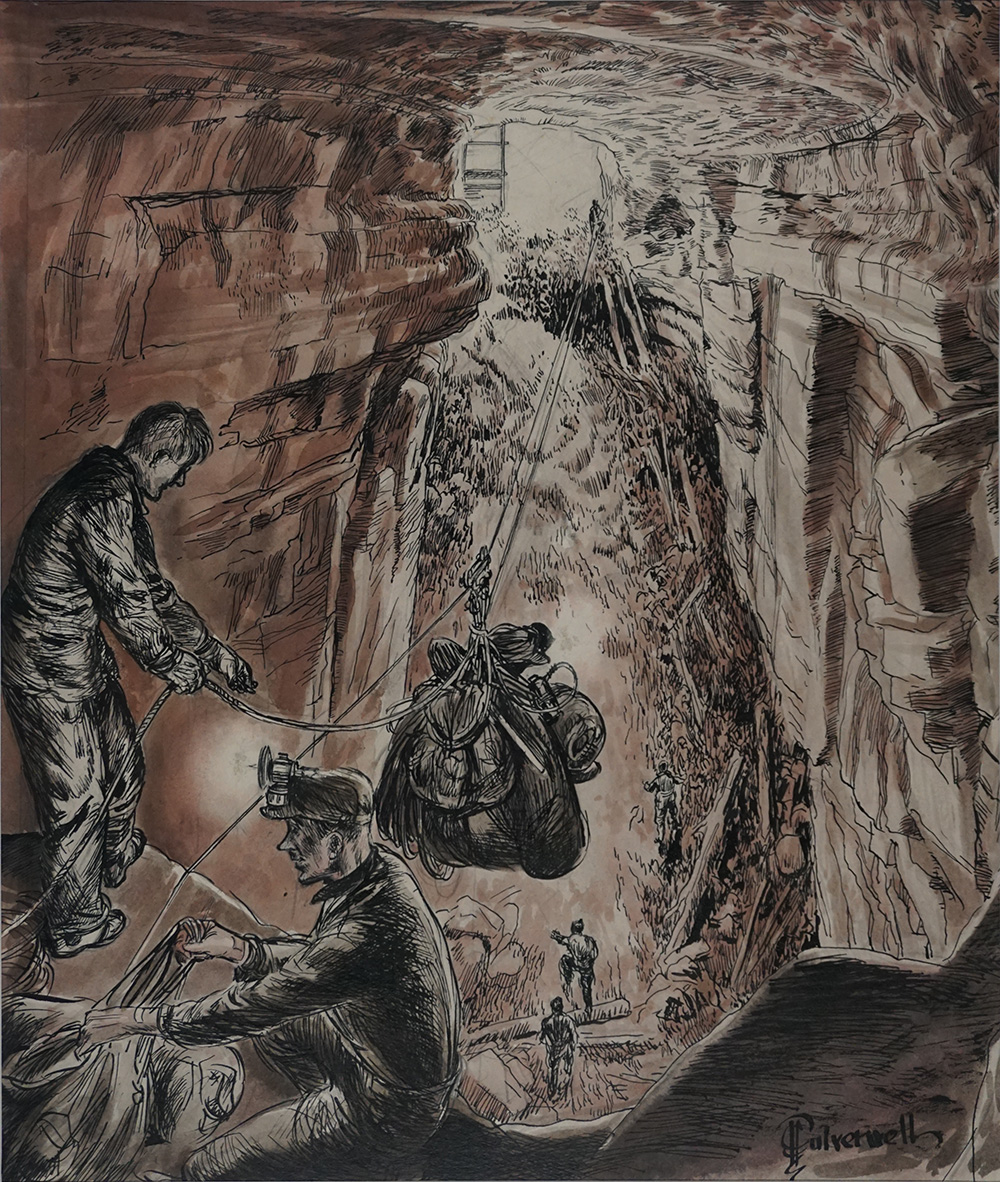
Cableway Across Entrance Room
Upon entering Schoolhouse Cave, one first descends a long rubble slope along the floor of the Entrance Room. From there, the explorer must regain much of this lost elevation in order to enter the Upper Passage–and the way onward into the cavern.
Rigging a highline cableway across the Entrance Room, these climbers provide a transportation alternative for their heavy packs and equipment.
An explorer is shown hauling a bundle of gear toward his elevated location, while a companion sorts additional equipment that will be needed further on.
Roping Down Into the Big Room
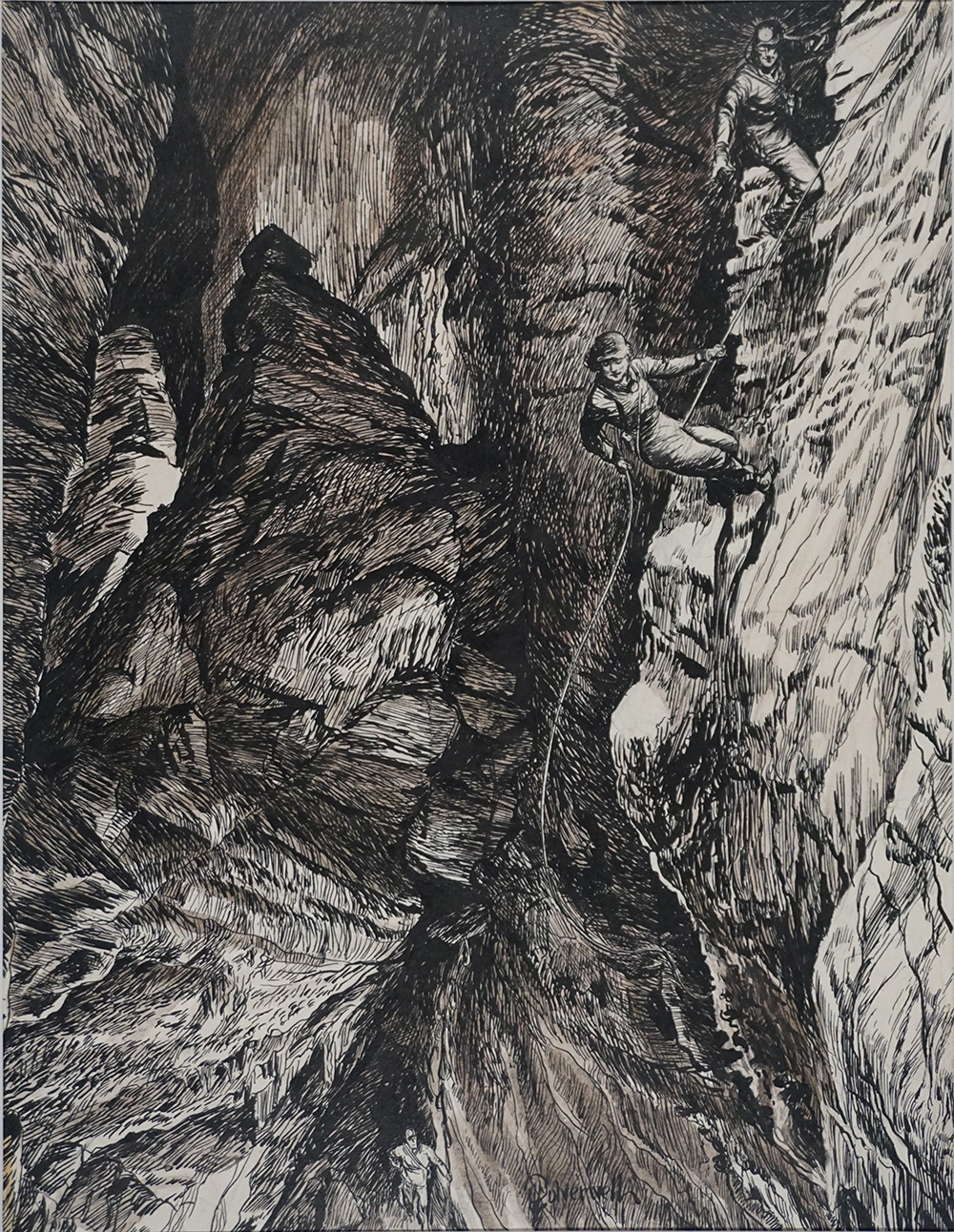
Pausing at the Jumping-Off Place in Schoolhouse Cave, even a hardy individual can be affected by the warning marked by carbide lamp on a nearby wall–“Abandon Hope All Ye Who Enter Here.”
Courageous enough to ignore the ominous inscription, early explorers of Schoolhouse often proceeded by shinnying down a cedar log from the Jumping-Off Place toward the first landing immediately below. Here, one might rig into a rappel in eager anticipation of safely roping down into the Big Room.
Along the way, those who moved too far to the right spied a steep and dangerous slope barreling into Cascade Pit. But, erring too far to the left swung the hapless explorer over the North Well.
An ideal descent headed straight for the rocky Nick of Time–fortuitously situated right between Cascade Pit and the North Well.
In this view, sixteen-year-old Marian Grove is descending, while Fitzhugh Clark observes her progress–and provides moral support–from his airy ledge. Far below, a fellow explorer awaits Marian’s safe arrival.
Traverse of the Gargoyle Bridge
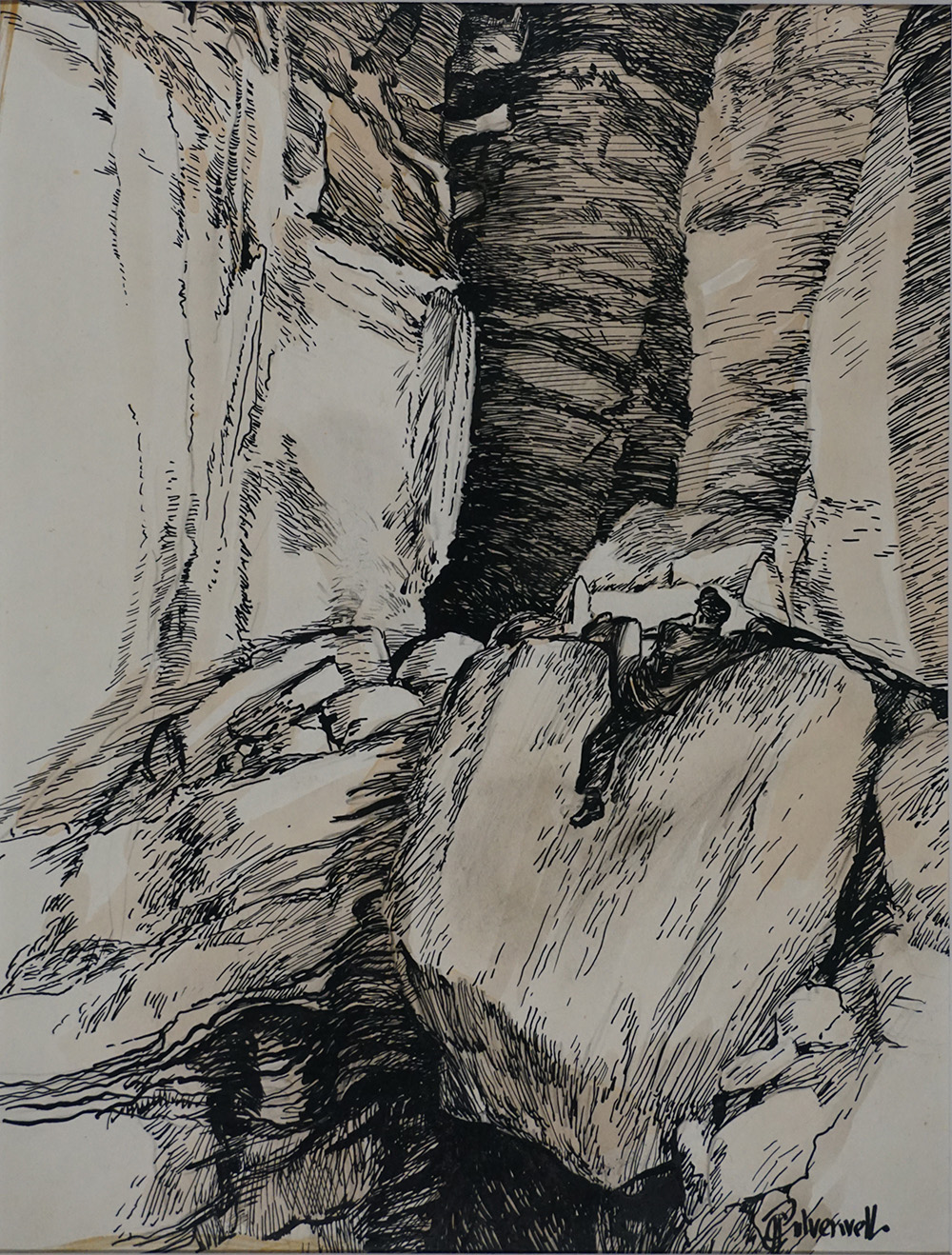
After passing the Big Bite and traversing loose rock along the right-hand wall, the climber is faced with making a traverse of the Gargoyle Bridge. Above him, it seems all of 100 feet to the ceiling of the Big Room. The overhead scenery taken in during his upward scan includes the Gargoyle formations–dimly visible in the upper portion of this picture.
The ominous-looking rock forming the Gargoyle Bridge itself appears to have fallen down from the walls above, somehow wedging itself into the precarious position shown.
Leo Scott swings his left leg over the apex of the Gargoyle Bridge. This move is in pursuit of an intricate route that ascends the West Wall in the general vicinity of the Inner Well complex.
If the explorer chances to peer down during his traverse of the Bridge, he looks 84 feet to the floor of the Gargoyle Pit.
The West Wall
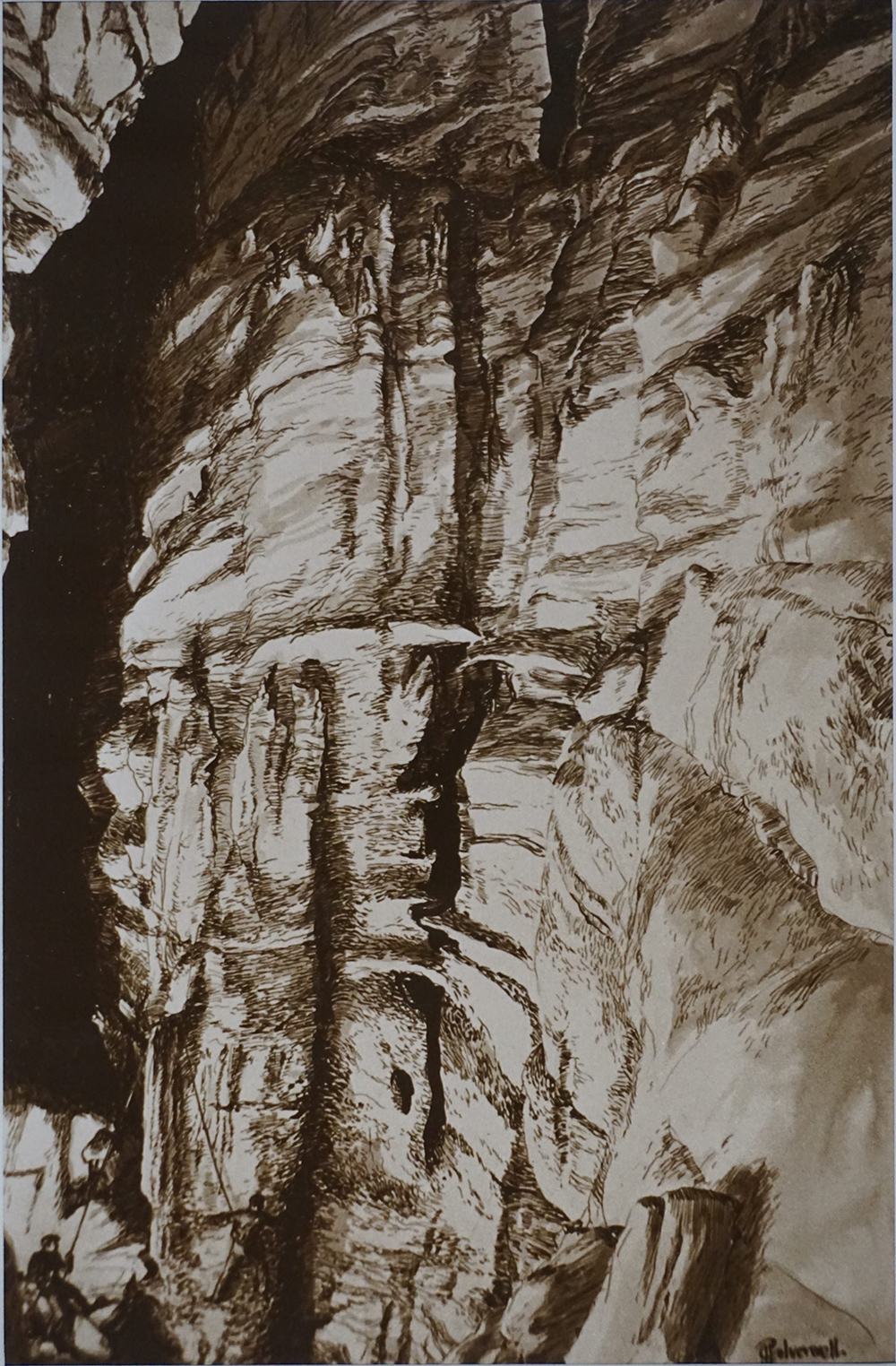
This drawing depicts a number of the features that characterize the complicated climbing route developed on the West Wall of the Big Room in Schoolhouse Cave.
The two cavers shown in the lower left of this image have successfully negotiated the Gargoyle Bridge and are preparing to ascend the steepness beyond.
In this view, a fellow explorer belays as Paul Bradt begins traversing to the right along a wall of the Gargoyle Pit. The sought-after prize–still many, many feet overhead–is a narrow traverse ledge that will come to be called the Angel Roost.
Entrance to the South Well
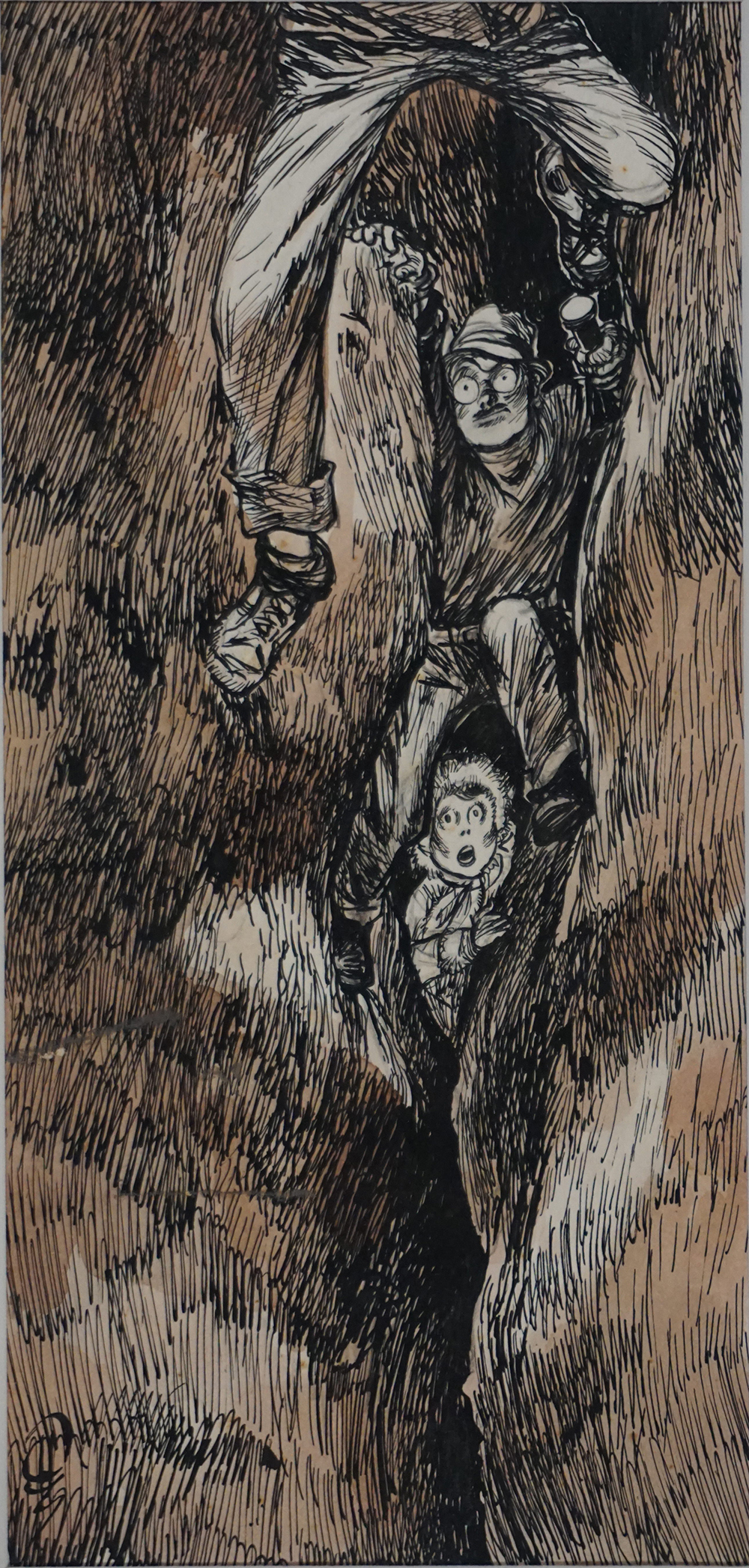
Leader Paul Bradt chimneys along a tricky canyon at the entrance to the South Well, followed by Tom Culverwell and Eleanor Pugh. Behind him, Paul’s companions look on with trepidation, fascination, and awe. For them–and for Paul–challenges such as Charlie’s Groan Box, the Inner Well, the Snootflute, and the Angel Roost await nearby.
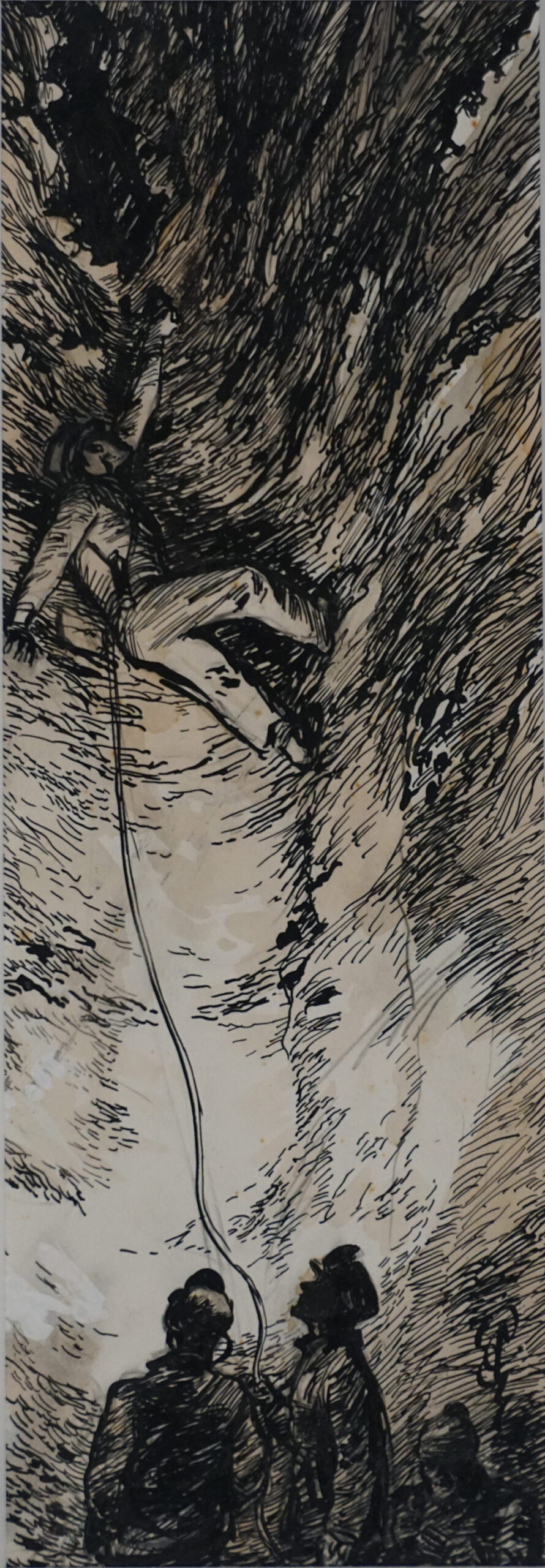
Climb Out of the South Well
Chris Scoredos–small and very strong–was an excellent climber with many years of experience, and a welcome addition to any exploration team.
Relying on his considerable abilities, Chris leads a climb out of the South Well as three of his fellow explorers evaluate his upward progress.
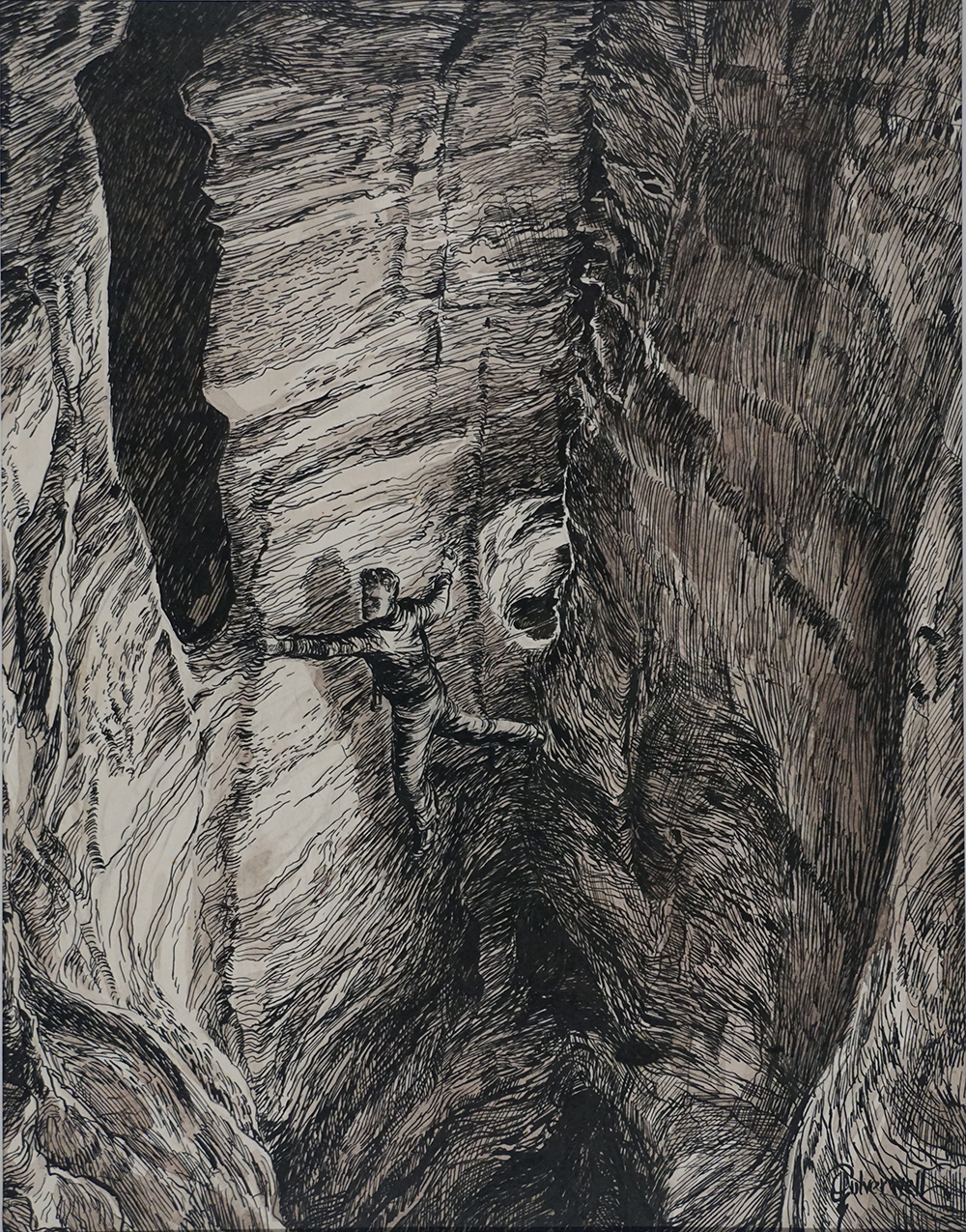
Traverse from Charlie's Groan Box
A climber (possibly Paul Bradt) traverses from Charlie’s Groan Box on the West Wall route to the Angel Roost.
As the climber ascends the involved West Wall route to the Angel Roost, along the way he must squeeze himself out of the lighted opening shown in the center of this picture. Oozing out headfirst, the adventurer aims his right hand for a tiny hold on the wall outside. But, because of the cave’s geometry, the explorer is unable to balance upright on his feet until after he is already committed to the move.
So, with plenty of exposure below, one slowly stands up and begins traversing left toward the dark, vertically-shaped window. In reality, the “hairy” part of the climb might extend for only about 10 feet. However, for some, it might as well be 10 miles.
At one point, Charlie Daniels found himself positioned in the room just behind the lighted opening at the center of this image. Daniels was a good climber and a great yodeler. On this occasion, while exercising his voice box, the resulting resonance sounded “like a cricket in an organ pipe.” Daniels’ vocal sounds reverberating around in the impressive chamber suggested the name “Charlie’s Groan Box.”
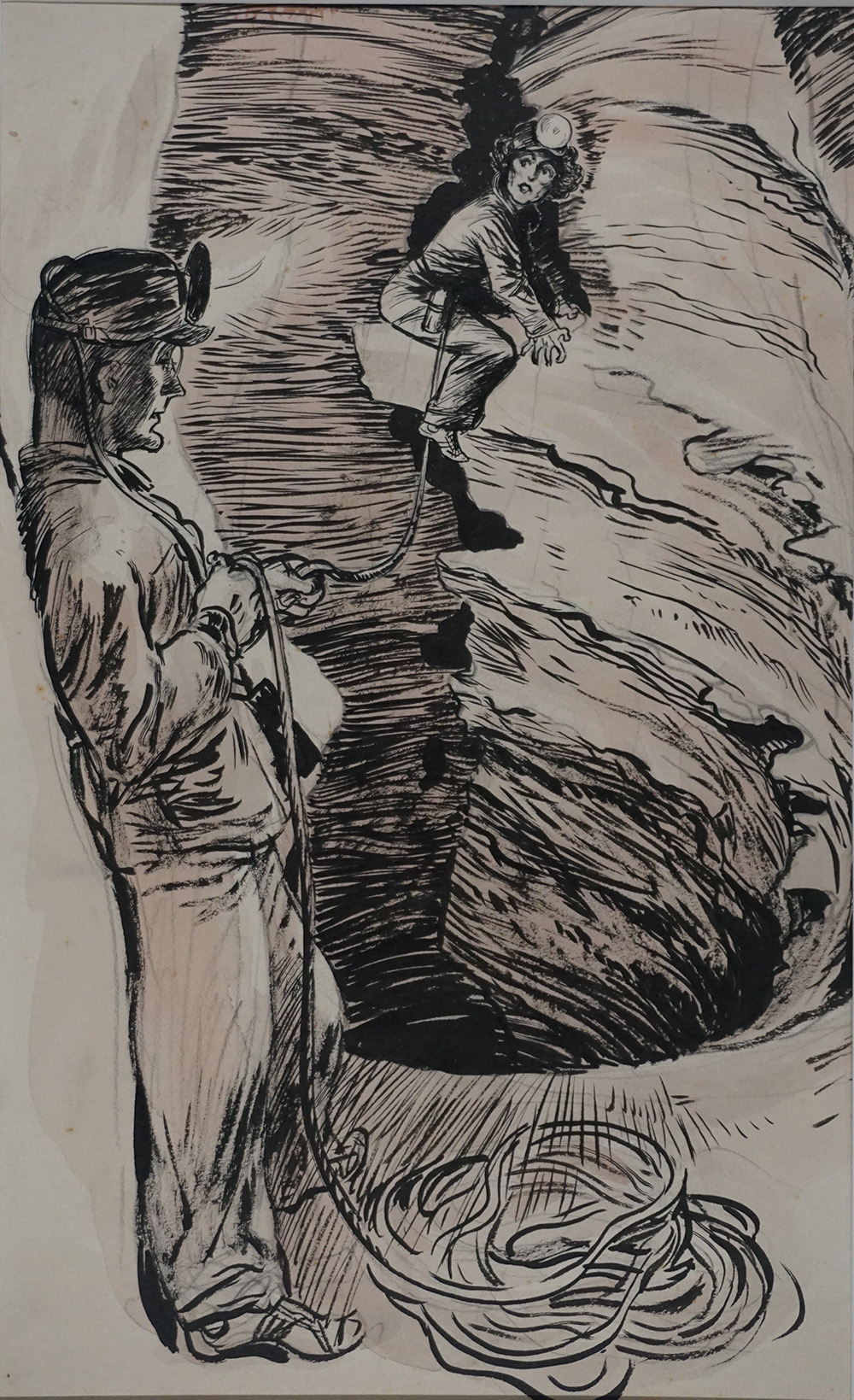
Fitzhugh Clark Safeties Geraldine
Heading north from the bottom of Charlie’s Groan Box, a tricky traverse takes the explorer across the Inner Well.
Beneath the archival matting on the original image, there is a hand-lettered note across the top of this picture.
The traverse across the Inner Well from the bottom of the Groan Box.
In this view, Fitzhugh (“Fitz”) Clark belays his friend Geraldine (“Jean”) across this Inner Well traverse. From the look on Geraldine’s face, she appears to be wishing that Fitz would pay a little more attention to her plight. But, as Jean would learn, Fitz always made it a point to appear especially casual when the going got tough.
Indeed, outside the field of the image itself, there appears another hand-lettered note on the bottom right-hand side of the drawing.
Jean thinks it must be a tough spot or the guide wouldn’t look so bored!
In spite of Jean’s astonished appearance, everything worked out all right. In fact, Fitz and Jean were later married. One wonders if Fitz might have popped the question when Jean was in a predicament such as the one illustrated here.
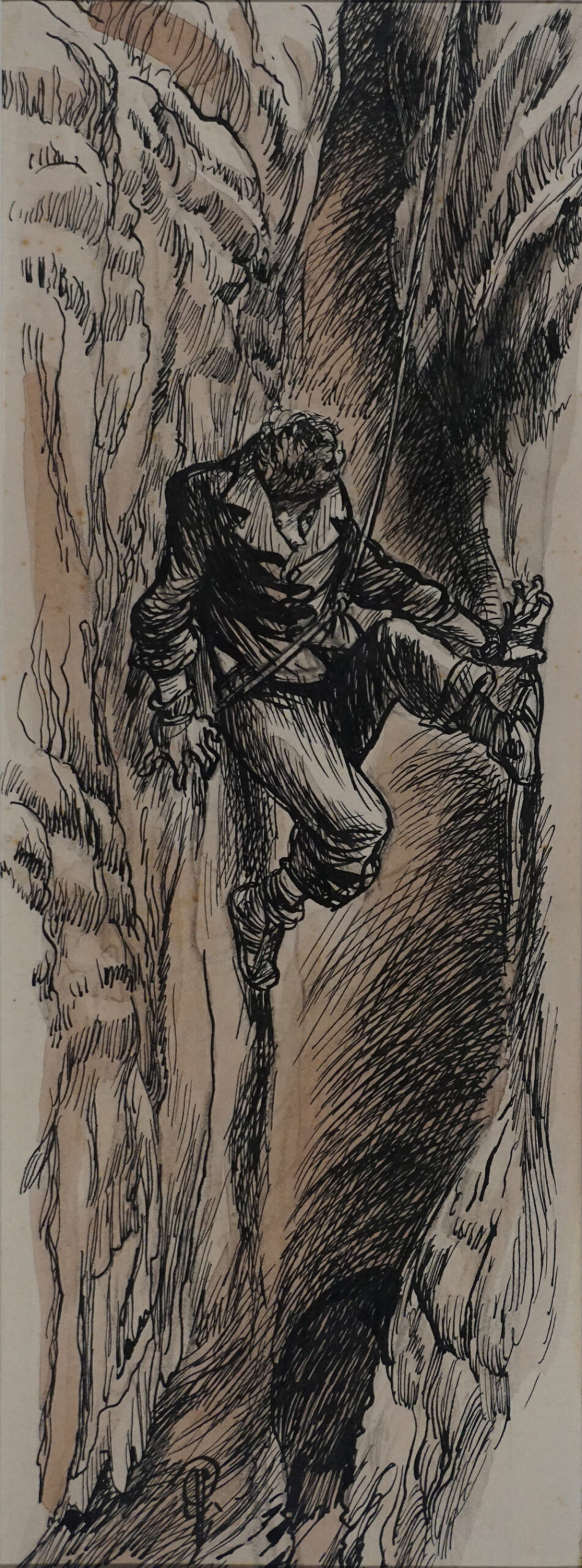
Mystery Well
Attempting to explore unknown territory above the high ledge of the Angel Roost, climber Paul Bradt has made an unsuccessful attempt at chimneying up the full extent of the Mystery Well. Stymied by the steepness on the sheer walls above–and by a constant cold rain falling through the darkness–Paul must reverse his moves via a tricky downclimb.
Using back-and-foot friction on the slippery walls, the explorer struggles against the waterfall-slicked surfaces. Adding insult to defeat, Paul’s shirttail is becoming undone. But, at this point, the climber cannot spare a hand to tuck it back in.
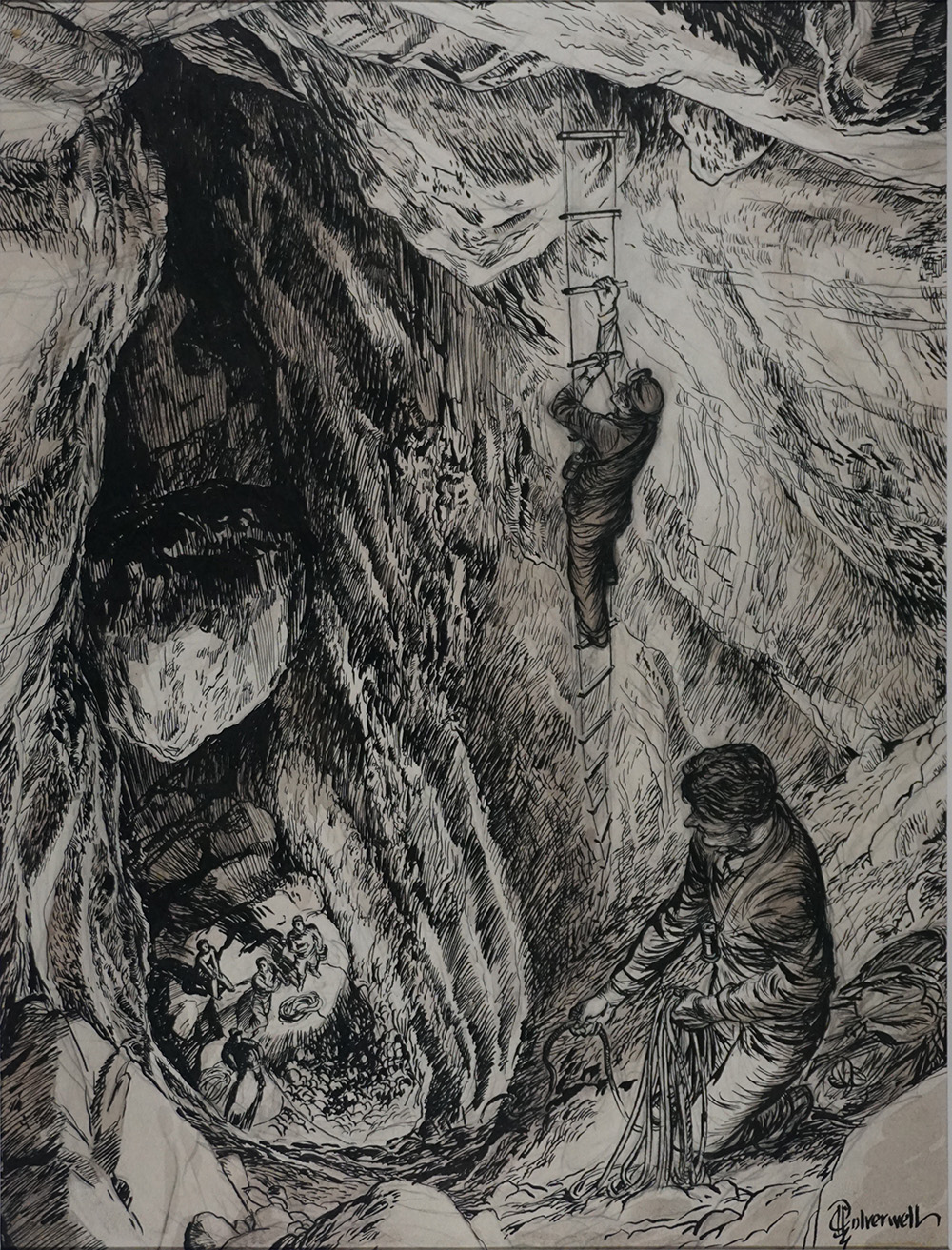
View from Scott's Climb
At the far side of the Big Room in Schoolhouse Cave a series of tricky and exposed exploratory climbs were performed. One of the resulting routes–Leo’s Climb (also known as Scott’s Climb)–was established when Leo Scott employed 24-inch rods to serve as surrogate “mud pitons.” These innovative tools, plus the digging of steps into the clay, allowed Scott to ascend the near-vertical slope at the rear of the Big Room.
Facing a long fall into the aptly-named Nightmare’s Nest if he slipped, Leo’s pioneering ascent ended at yet another obstacle. Later, further work circumvented this temporary end using a traversing route involving the Angel Roost.
Near the eventual intersection of these alternative routes, a spectacularly-perched chockstone was found. Affording expansive views of the Big Room below, it was logically named the Judgment Seat.
Subsequent groups, in order to expedite movement to a good staging area for further exploration, rigged a ladder from this airy chockstone to the slope below. Climbing along the shortcut route to even more remote portions of the cave, an explorer traverses a free-hanging ladder made fast to the summit of the Judgment Seat.
In this image, Tom Culverwell depicts himself negotiating the ladder, while his friend Paul Bradt is shown coiling a rope.
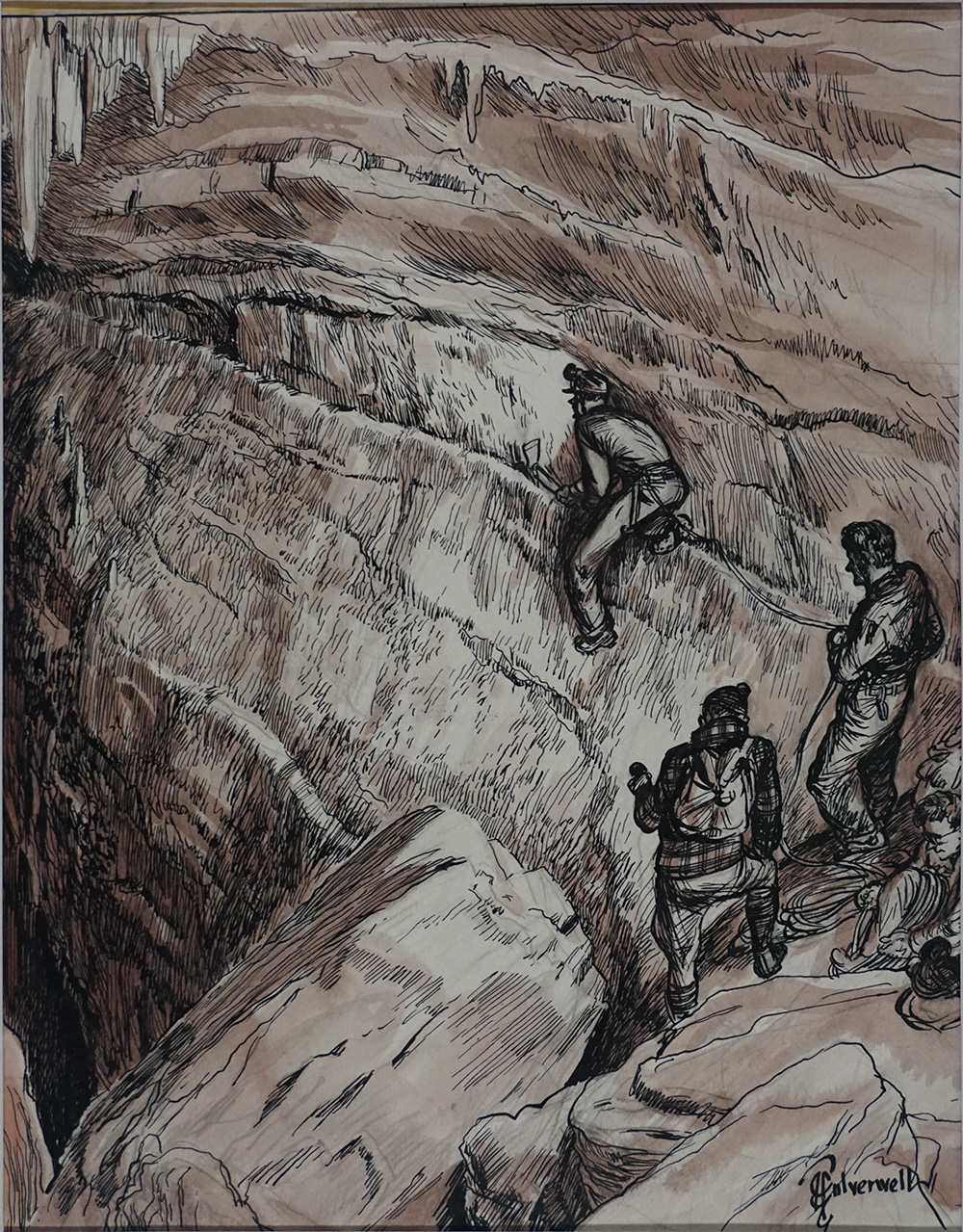
Traverse in the Hodag Room
Pushing onward and upward from near the Judgment Seat, Fitzhugh Clark ascended to an opening near the ceiling of the Big Room. In honor of his efforts, the route was dubbed Clark’s Climb.
Immediately after completing the exposed Clark’s Climb above the Judgment Seat, the explorer must traverse the Hodag Room. A hodag is an imaginary animal with legs on one side of its body characteristically longer than those on the other. By this means, the hodag has become adapted to walk comfortably along a slanting hillside.
This room was first crossed via a delicate balance climb performed by Paul Bradt and Tom Culverwell at the level down by the small stalagmites. Deciding that the upper ledge was marginally more practical, subsequent trips employed the alternative illustrated here.
Sliding along on his right knee, wielding something resembling a short pick or a mountaineering ice axe, Leo Scott cautiously moves across the aptly-named Hodag Traverse using the inches-wide Hodag Ledge. Leo’s advance is being safetied by Paul Bradt. Don Hubbard observes from Paul’s left, while Tom Culverwell coils a rope nearby.
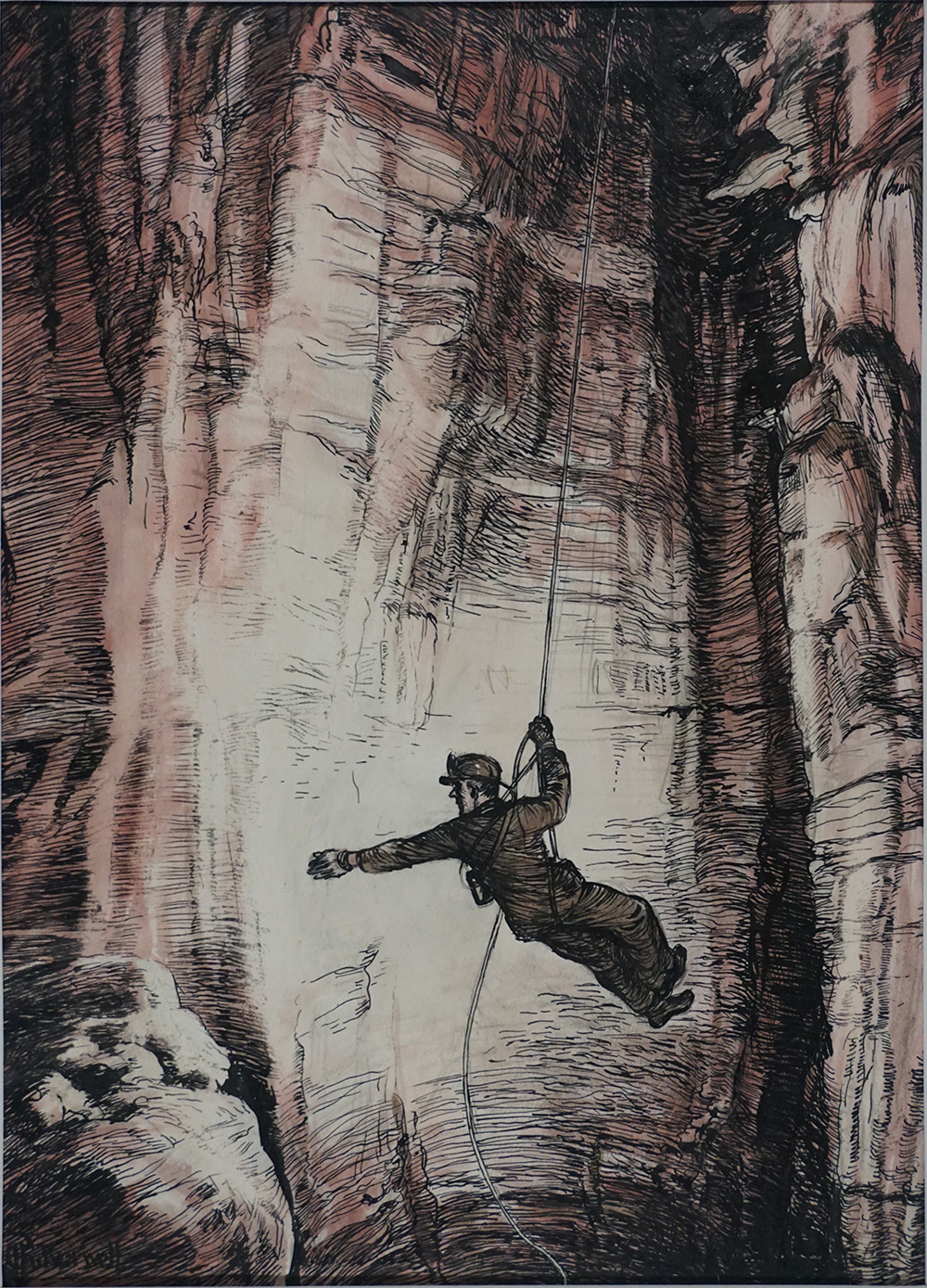
The Pendulum Pit
Beyond the Hodag Room, the passage continues near the ceiling toward another huge chamber. There, after descending about 75 feet down a steep slope, the climber finds himself at the brink of a sheer drop. Rappelling down part of the way, he stops, pushes off an available surface, swings across a troublesome section, and engineers a landing at a notch on the far side of the Pendulum Pit.
Tom Culverwell was a key member of the very first team that successfully traversed this imposing obstacle.
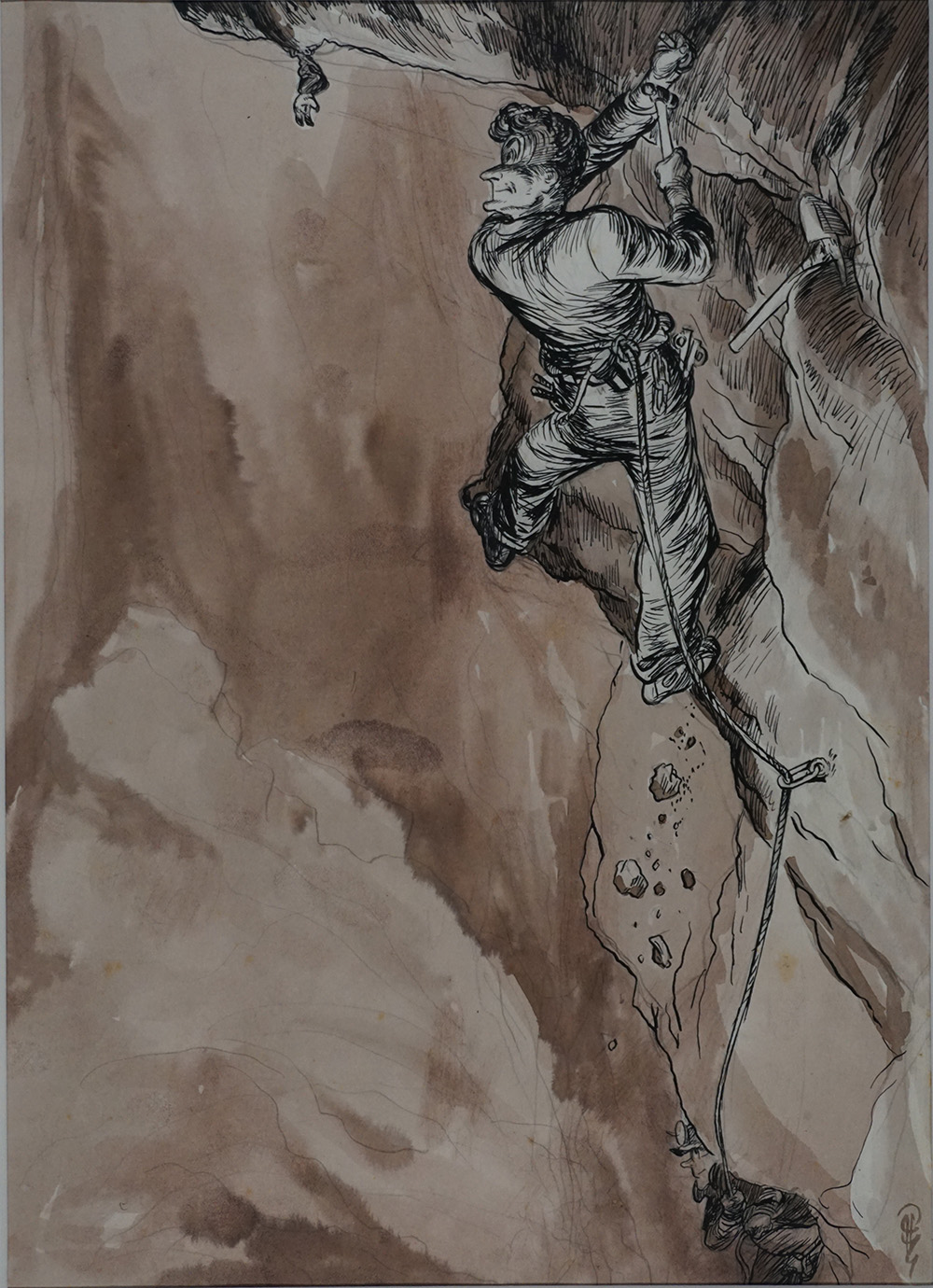
The South Wall of the Thunderbolt Room
In an earlier probe beyond the Hodag Room, the climbers discovered a monstrous cavern with Schoolhouse Cave’s characteristic flat ceiling, and a floor riddled with pits and other hazards. Concentrating their lights to peel back the darkness, the explorers illuminated what resembled a white streak seemingly “flashing” across the ceiling of this new chamber–a fantastic cavern soon named the Thunderbolt Room.
In this picture–sometimes referred to by the alternate title “Expansion Bolt Climb in the Thunderbolt Room”–both the bat and the climber seem skilled at clinging to small holds. Estimating the wall to have only the consistency of a Graham cracker, Paul Bradt hustles to place an expansion bolt while his furry friend smugly looks on. Below, Bradt’s belayer is anchored to a mud piton while stones dislodged by Paul’s efforts rattle past.
Aiming for an intriguing opening near the ceiling, Paul is hopeful of discovering more passage above the south wall of the Thunderbolt Room.
The Great Gallery
A short scramble from the south end of the Thunderbolt Room deposits the explorer in the Great Gallery. The Great Gallery includes a level passageway interrupted by the two pits illustrated in this view. Water flows down the wall, temporarily accumulates in a beautiful pool, and finally overflows via a steady series of drips into the pit occupying the lower left-hand portion of the picture. The resulting sounds emanating from the depths suggested the name the Singing Well.
Still seeking additional passageways, Don Hubbard is gingerly crawling along the inches-thick ledge near the far wall, while a smiling Paul Bradt carefully belays Don’s probing traverse. As several other explorers monitor Don’s progress, caver Lowell Bennett crouches nearby.
Meanwhile, hoping the thin ledge that Don is pursuing might be bypassed altogether, Leo Scott is investigating the narrow bridge in the foreground. Although Hubbard’s route held together, most subsequent explorers elected to scoot along the bridge between the two pits.
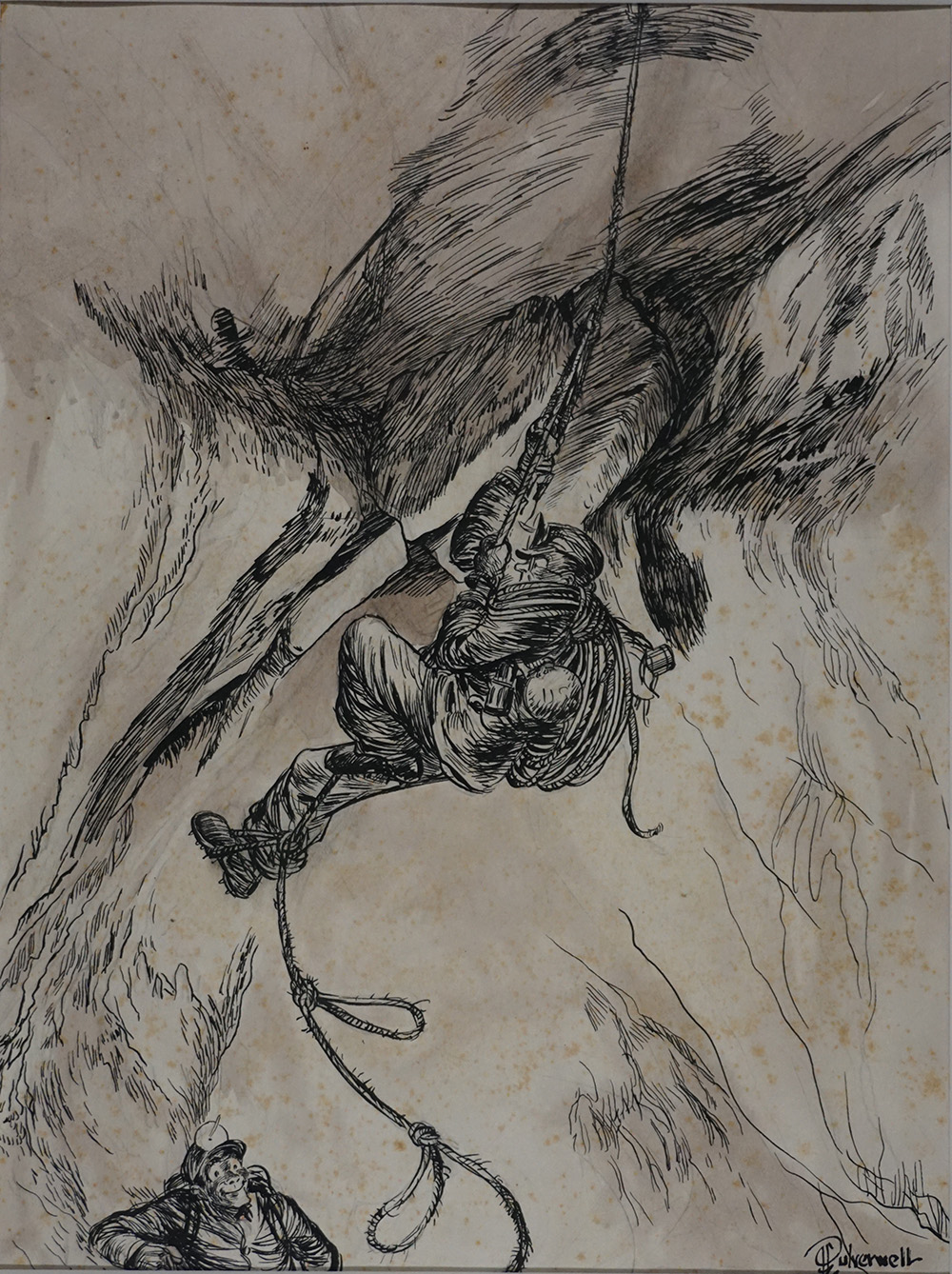
Design for Exhaustion
A mountaineering rope with knotted loops provides some aid to the heavily-burdened climber. But, his mounds of equipment and weighty pack conspire to pull him over backward. Moreover, the construction of the twisted rope causes him to spin. Sometimes, he must temporarily tolerate his carbide flame singeing his hand if the only alternative means burning the rope.
In this view, Tom Culverwell illustrates his own personal struggle beneath the overhang at the top of the Grotto. Lowell Bennett looks on from below.
On the way down this crude rope ladder, the explorer has unknown hazards and monumental challenges on his mind. On the way back out, he might be looking forward to a warm dinner and a sleeping bag after 18 or more hours in Schoolhouse Cave.
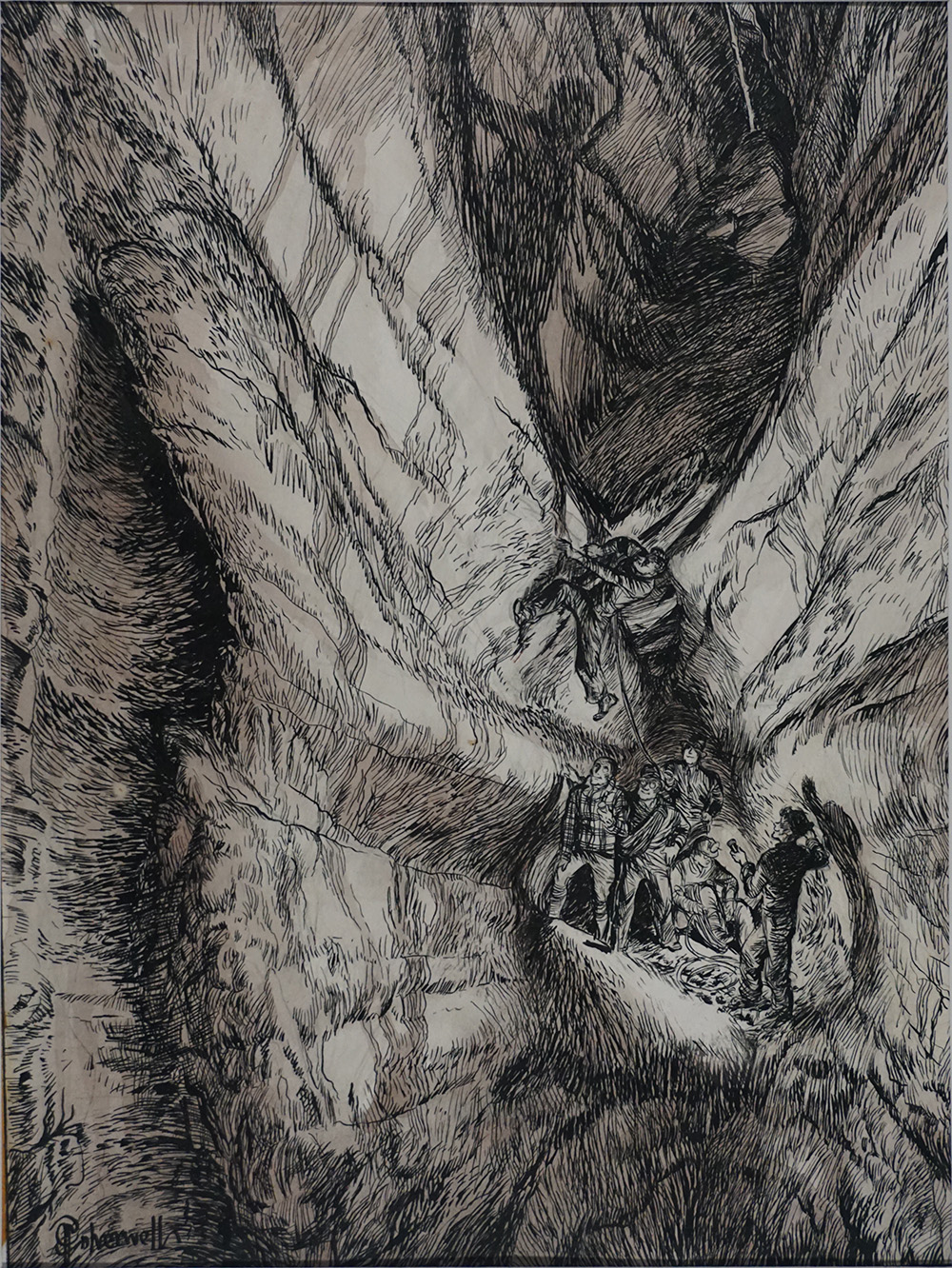
Climb from Grotto
Prior descents and ascents of the long sheer slope between the Jumping-Off Place and the Big Room in Schoolhouse Cave had been negotiated with the direct aid of a cedar log and crude ladders or ropes. But, in lieu of employing a dangling rope ladder when ascending from the Grotto, these explorers have elected to attempt an alternative free-climbing variation in order to return to the surface.
In this image, Paul Bradt is free-climbing back out of the upper portion of the ascent route from the Grotto below the Jumping-Off Place. In the back of the explorer’s mind is the heart-throttling realization that the slope in the foreground plummets down into the Big Room.
In this unusual view, Culverwell cleverly positions the viewer out in space-above, but near, the final drop into the Big Room.
While Paul climbs, other friends and explorers populate the Grotto below him. Don Hubbard stands on the left, and a fellow adventurer holds a flashlight to assist in Paul’s efforts.
A short time after the scene depicted here, Paul also surmounted the final overhang to the Jumping-Off Place dimly seen in the shadows at the top rear of this image. To do so, Bradt resorted to a technique called the courte échelle–a fancy mountaineering term that describes the time-honored expedient of standing on the shoulders of a partner in order to extend one’s reach!
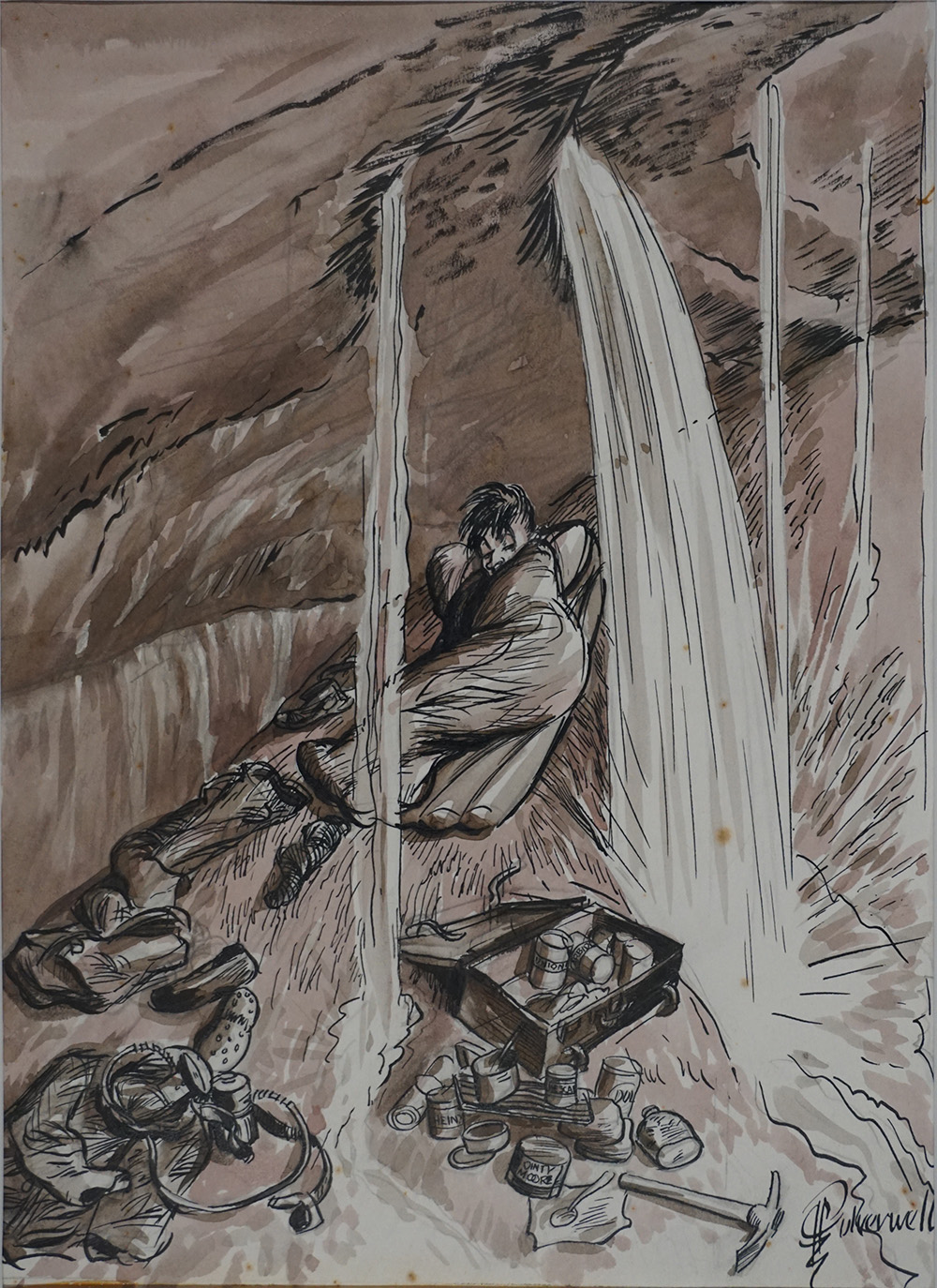
Night of the Big Rain
Much of the Entrance Room in Schoolhouse Cave is rock-strewn slope. But, in a few spots, an explorer can make his camp at the end of another assault.
Perched atop his air mattress, Arthur Lembeck endeavors to grab some shut-eye after a long day of exploration. Around him are the tools of his hobby: climbing gear, Army-issue equipment, and food containers. The tin can in the foreground is labeled “Dinty Moore”-a staple of cavers for generations.
Outside, a colossal rainfall has created unexpected, and unusual, waterfalls in the cave. In this view, Art seems somehow oblivious to the flooding going on right beside him.
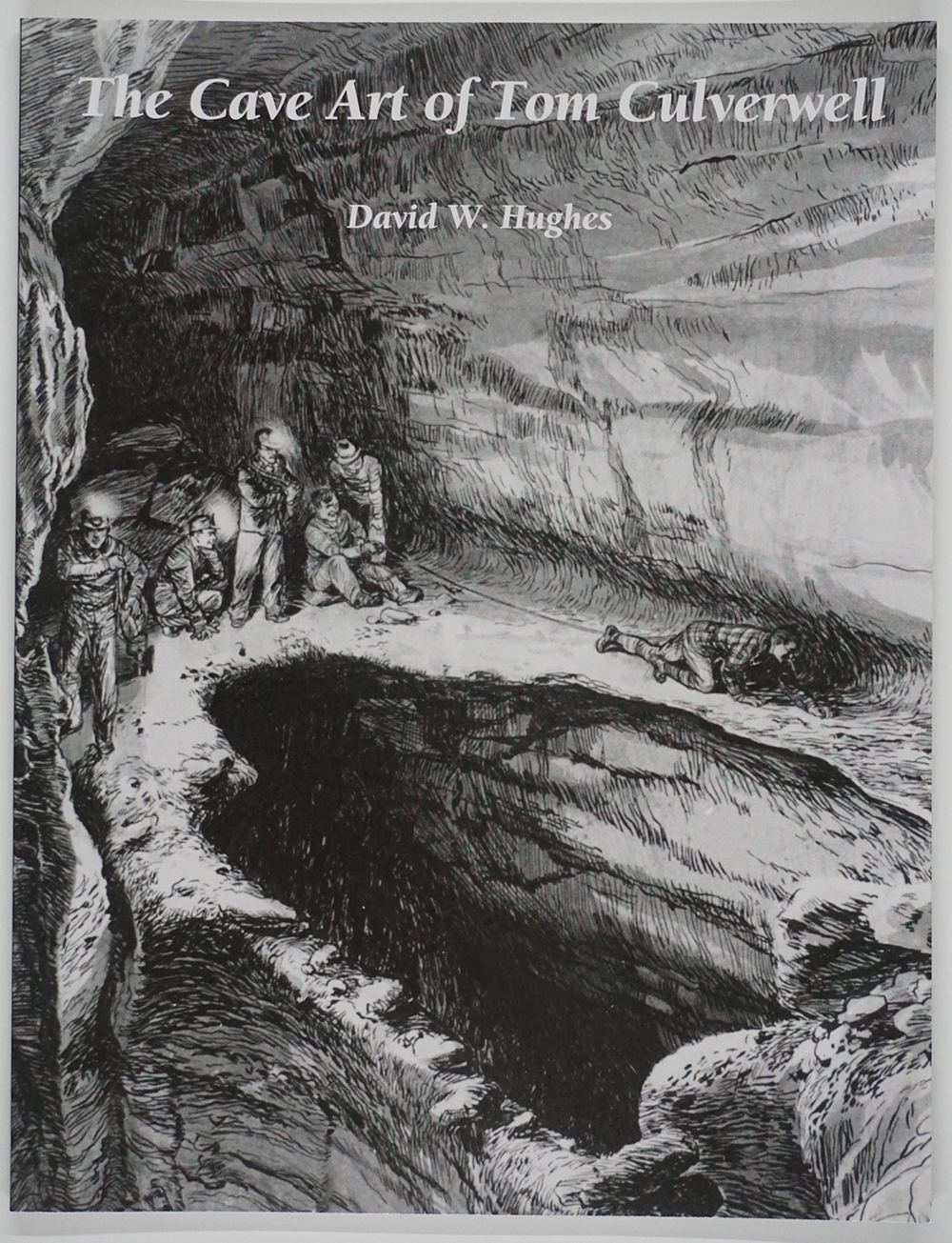
The Cave Art of Tom Culverwell
The descriptions in this exhibit are taken primarily from the book The Cave Art of Tom Culverwell by David W. Hughes. The book is available from the Bookstore of the National Speleological Society (NSS) in Huntsville, Alabama or on the website of the NSS at caves.org.
You can find additional information on caving on the NSS website or by calling or visiting the National Speleological Society, 6001 Pulaski Pike NW, Huntsville AL 35810, 256-852-1300. The NSS has an extensive library of cave related books and articles at the NSS Headquarters in Huntsville.
You can locate a local caving club (Grotto) of the NSS on the NSS website at caves.org.
Caving is a dangerous sport. Caves also contain formations and animals that can be easily harmed by careless people. Please contact experienced cavers through a Grotto or the NSS who can train you on how to safely explore the amazing underground world. Reading about caves is no substitute for in-person training.
To Explore Further
Anon. (with photographs by Elwood Baker), “Cave Explorers Find Nearby Wonders,” Washington Star, Gravure Section, Page 3, November 26, 1939.
Anon., “A Picture Story of Schoolhouse Cave,” Bulletin Eleven of the National Speleological Society, Pages 45-50, November 1949.
Tom Culverwell, “Mountaineering Under West Virginia, Just For Fun,” Potomac Appalachian Trail Club Bulletin, Pages 2-12, January 1941.
Tom Culverwell, “Subterranean Rock Climbing,” Appalachia, New Series, Volume IX, Number 7, Magazine Number 95, Pages 340-341 (plus six illustrations), June 1943.
Tom Culverwell, “On Underground Trails,” Potomac Appalachian Trail Club Bulletin, Pages 84-90, October 1943.
Tom Culverwell, “About As Far As We Can Go,” Potomac Appalachian Trail Club Bulletin, Pages 91-100, October 1944.
Tom Culverwell, “Potomac Basin’s a Cave Crawler’s Eden,” The Washington Post Times Herald, Page 17, May 22, 1956.
George R. Dasher, The Caves and Karst of Pendleton County, West Virginia Speleological Survey, Bulletin # 15, Pages 290-303, August 2001.
William R. Halliday, M.D., Depths of the Earth: Caves and Cavers of the United States, Harper & Row, New York, New York, Pages 19-33, 1966.
William R. Halliday, M.D., Depths of the Earth: Caves and Cavers of the United States, Revised and Enlarged Edition, Harper & Row, New York, New York, Pages 61-74, 1976.
Dave Hughes, “Tom Culverwell,” Georgia Underground, Volume 40, Number 2, Pages 1-15, June 2005.
Carter Brooke Jones (with photographs by Elwood Baker) “D.C. Explorers Search Cave Which May Rival Mammoth,” Washington Star, Page A1, November 16, 1939.
Janet McCormick and John Meenehan, “Culverwell Drawings Donated To Society,” NSS News, Volume 38, Number 2, Pages 32-33, February 1980.
John Meenehan, “Script” of a slide show entitled “The Culverwell Drawings,” Slide Presentation No. S-911, National Speleological Society, 1980.
Ida V. Sawtelle, “Assault on Schoolhouse,” in Celebrated American Caves, Charles E. Mohr and Howard N. Sloane, Editors, Rutgers University Press, New Brunswick, New Jersey, Pages 59-77, 1955.
H.F. Stimson, “The Survey of Schoolhouse Cave, With a Series of Drawings and a Sketch Map by Tom Culverwell,” Bulletin Twelve of the National Speleological Society, Pages 43-53 (plus map), November 1950.
H.F. Stimson and Tom Culverwell, “The Survey of Schoolhouse Cave, With a Sketch Map of Schoolhouse Cave,” Potomac Appalachian Trail Club Bulletin, Pages 1-9, January 1945.
Patrick J. White, “The Devil’s Sinkhole,” Bulletin Ten-The Caves of Texas, National Speleological Society, Pages 2-14, April 1948.
